
You spot “boi” in a text, a meme, or an Instagram caption and pause. Is it a typo? A joke? An insult? None of those by default “boi” is one of the most flexible pieces of internet slang around, and its real meaning shifts depending on tone, platform, and who’s saying it.
One minute it’s a friend teasing you for being late, the next it’s a caption reacting to a wild Ticktock clip, and in a completely different setting, it’s not slang at all but a business acronym with a serious legal meaning.
This guide breaks down exactly what “boi” means in every context you’re likely to run into, where the word came from, and how to use or respond to it naturally. By the end, you’ll be able to read the room instantly and never have to second-guess a “boi” text again.
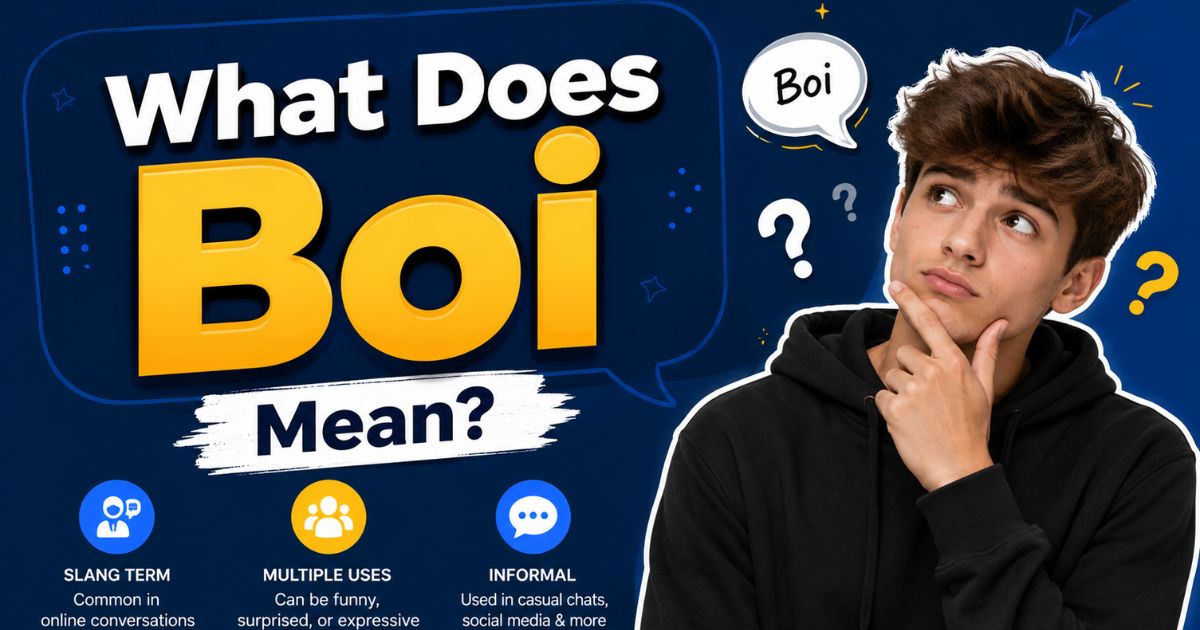
What Does Boi Mean – Quick Meaning
“Boi” is an informal, stylized spelling of “boy.” People use it to:
- Playfully call out a friend
- Greet someone casually
- React to something surprising or dumb
- Show affection or approval
- Refer to gender identity within LGBTQ+ communities
The exact meaning depends entirely on tone, platform, and who’s saying it.
Origin & Background
Where it came from
“Boi” isn’t new internet slang; it has roots in African American Vernacular English (AAVE) and in queer and skateboarding subcultures from the 1990s, where it was used as a deliberate alternative spelling of “boy.” Around the same time, rapper Antwan Patton adopted the stage name Big Boi, helping push the spelling into mainstream hip-hop culture.
How it evolved
By the 2000s, “boi” had picked up extra layers of meaning in LGBTQ+ spaces, describing masculine-presenting women, young trans men, or gender-nonconforming individuals. It was also embraced within skateboarding, punk, and emo scenes as a way to express a softer, less rigid form of masculinity than the traditional “boy.”
Then in 2015, a meme featuring a frog on a unicycle captioned “here come dat boi” went viral, introducing the word to a whole new generation as a piece of internet comedy, stripped of its earlier subcultural meaning. Today it lives in texting, gaming chats, and social captions as a catch-all casual term that most people use without knowing its full history.
Real-Life Conversations (How People Actually Use “Boi”)
Seeing the word in action makes the meaning click faster than any definition.
WhatsApp Chat
“Boi where were you today?? We waited an hour 😭”
Here it’s a light scolding between friends, no real anger, just teasing.
Instagram DMs
“That fit is fire boi 🔥”
Used as a casual, gender-neutral way to address a friend while giving a compliment.
TikTok Comments
“BOI 💀💀 I was NOT ready for that plot twist”
This is the reaction use pure disbelief or shock, often paired with emojis for extra emphasis.
Emotional & Psychological Meaning
Why people connect with it
“Boi” feels warmer and less formal than “boy.” The misspelling itself signals playfulness before the message is even read, which lowers the emotional stakes of teasing or joking. It softens criticism and makes affection feel casual instead of heavy.
What it reflects
Using “boi” often reflects belonging. It’s an in-group marker, a way of signaling that you’re fluent in internet culture, comfortable with a friend, or part of a specific online or cultural community. It also gives people a flexible way to express identity without needing formal, rigid labels.
Linguists sometimes describe this pattern as “phonetic respelling” changing the spelling of a common word without changing how it sounds. This small tweak is enough to shift a word’s entire emotional register, which is part of why “boi” spread so easily across texting and social platforms.
Usage in Different Contexts
What does boi mean in Spanish
“Boi” isn’t a native Spanish word, but Spanish speakers online use it the same way English speakers do as a loanword borrowed from internet slang, mainly to react to something shocking or to address a friend casually in chats and comments.
Read Me:TP Meaning Explained
Social Media
On platforms like TikTok and X (formerly Twitter), “boi” mostly shows up as a reaction word, often stretched out (“boiiii”) for comedic emphasis.
Friends & Relationships
Among close friends, “boi” is a term of endearment or gentle teasing. It rarely carries real hostility in this setting.
Work or Professional Settings
“Boi” almost never appears in professional communication as slang and if it does, it can come across as unprofessional. In business contexts, “BOI” usually means something completely different (more on that below).
Casual vs. Serious Tone
| Tone | Typical Use | Example |
| Casual/Playful | Teasing a friend | “Boi stop lying 😂” |
| Reactive/Shock | Responding to news | “BOI WHAT” |
| Affectionate | Showing warmth | “That’s my boi” |
| Identity-related | LGBTQ+ context | Self-identification or community terminology |
| Insulting | Rare, context-dependent | Used to mock or belittle |
Common Misunderstandings
1. It always means “boy”
Not quite. While it started as a spelling variant of “boy,” it now functions as an all-purpose reaction word and identity term too, not a literal reference to a male child.
2. It’s insulting
Most uses today are playful, not offensive. Tone and relationship context determine whether it lands as teasing or as a jab.
3. It’s universally acceptable
Slang carries different weight in different communities. What’s affectionate between close friends can feel dismissive or inappropriate in a formal or unfamiliar setting.
Boi meaning on Instagram
On Instagram, “boi” typically shows up in captions and comments as a fun, low-key way to hype someone up, react to a photo, or address followers collectively closer to “hey guys” than any literal meaning.
4. It’s gender-specific
Despite its root word, “boi” is frequently used regardless of gender. Friends call each other “boi” across genders in casual chats without it referring to biological sex at all.
Variations & Types of “Boi”
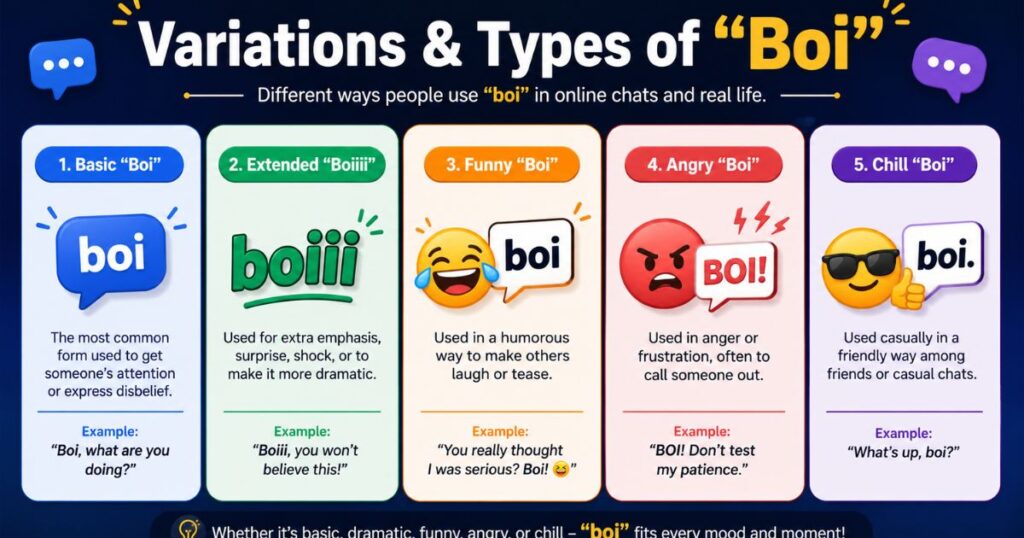
- Boiii stretched for extra emphasis or drama
- Sad boi describes a moody, sensitive online persona
- Soft boi a gentle, emotionally open male persona, often used self-deprecatingly
- Big Boi a nod to confidence, swagger, or the rapper’s stage name
- Here come dat boi the viral meme reference, used purely for comedic timing
How to Respond When Someone Uses “Boi”
Casual Replies
- “Lol yes boi”
- “You already know”
Funny Replies
- “Boi don’t start with me 😭”
- “Say less, boi”
Mature / Confident Replies
- “Ha, fair point.”
- “Guilty as charged.”
Private or Respectful Replies
If it’s used in an LGBTQ+ identity context, the respectful move is to mirror the language the person uses for themselves rather than questioning or redefining it.
What does boi mean in business
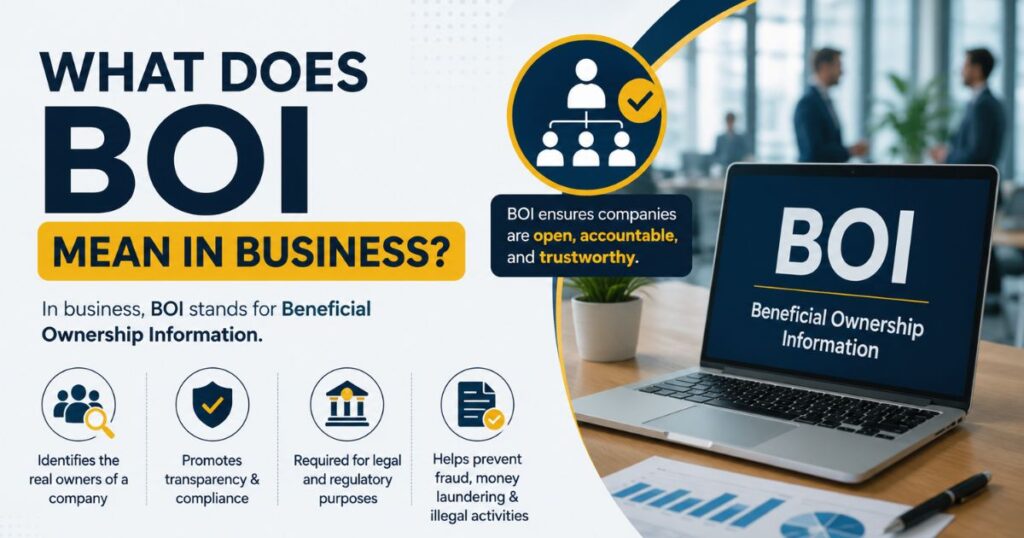
Outside of slang, BOI stands for Beneficial Ownership Information, a completely unrelated term used in U.S. business compliance. It refers to data identifying the real individuals who own or control a company, collected under the Corporate Transparency Act and overseen by FinCEN (the Financial Crimes Enforcement Network). This BOI has nothing to do with the internet slang term and is used strictly in legal, financial, and regulatory contexts.
Regional & Cultural Usage
Western Culture
In the U.S. and U.K., “boi” is common in youth slang, memes, and casual texting, with roots also in AAVE and queer culture.
Asian Culture
In many Asian online communities, “boi” is used mainly as an imported internet reaction word, especially in gaming and meme culture, without the deeper LGBTQ+ connotations it carries in the West.
Middle Eastern Culture
Usage here is largely limited to younger, internet-fluent audiences who use it in English-language social media interactions, mostly for humor or emphasis.
Global Internet Usage
Thanks to memes and cross-platform sharing, “boi” has become a genuinely global reaction word, understood even by non-native English speakers as an expression of shock, humor, or casual address. Its short length and exaggerated spelling make it easy to type, easy to stretch out for emphasis, and easy to recognize across language barriers which is exactly why it keeps resurfacing in new meme formats year after year.
Conclusion
“Boi” is one of those words that proves slang isn’t static; it bends to fit the moment, whether that’s a joke between friends, a reaction to a wild TikTok, or a marker of identity within a community.
Context is everything: read the room, match the tone, and you’ll never misuse it. Now that you know where it came from and how it’s used today, you can spot the difference between a friendly “boi” and one that means something more.