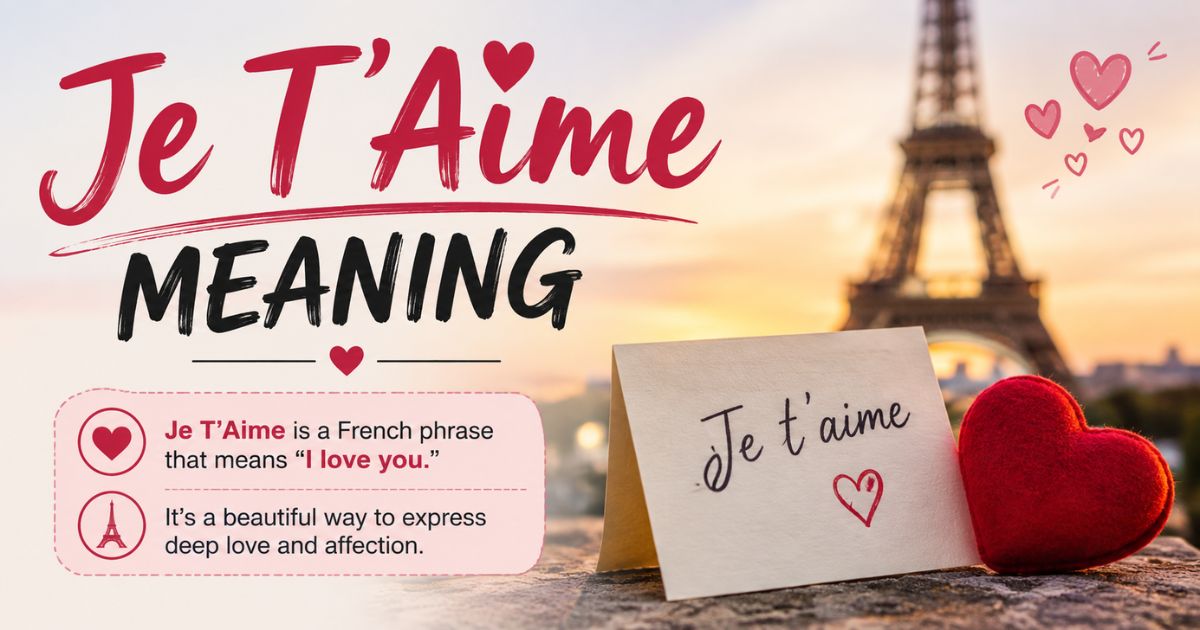

Je t’aime is French for “I love you,” but that one-line translation hides more than it reveals. The phrase carries weight in French that “I love you” doesn’t always carry in English, and using it in the wrong moment can send a message you didn’t intend. This guide breaks down what je t’aime actually means, how native speakers use it, and where people commonly get it wrong.
You’ll also see how it compares to close cousins like je t’aime bien and je teatime AUSSI, how to pronounce it correctly, and how to respond if someone says it to you.
So Someone Said Je T’Aime to You
If someone just texted or said je t’aime to you, take it seriously. This is not a casual phrase in French the way “love you” can be in English between friends or coworkers signing off a message. Je t’aime is usually reserved for romantic partners or extremely close family, and French speakers tend to save it for moments that actually mean something.
That doesn’t mean every use is a grand declaration. A partner might say it at the end of a phone call the same way an English speaker says “love you, bye.” But the phrase still sits in a more guarded emotional space than its English equivalent. If it came from someone you’re dating or in a relationship with, it’s safe to read it as genuine.
What Makes This Phrase Different From “I Love You”
English speakers use “I love you” loosely. People say it to friends, parents, pets, and even food. It’s sincere, but it stretches across a wide range of relationships and intensities.
The French treat je t’aime with more restraint. A few things set it apart:
- It’s typically reserved for romantic partners and immediate family (parents, children, siblings).
- French speakers rarely say it to casual friends, even close ones.
- Saying it too early in a relationship can feel intense or premature to a French listener.
- There’s a whole set of softer phrases (covered below) that exist specifically so people don’t have to say je t’aime when they mean something less.
In short, English gives you one phrase for many levels of affection. French gives you several phrases, each pointing at a different level.
The One Difference That Trips Everyone Up

The single biggest source of confusion is the word bien. Add it to je t’aime and the meaning doesn’t get stronger, it gets weaker. Je t’aime bien translates literally as “I love you well,” but it actually means “I like you” or “I’m fond of you.”
This trips up English speakers constantly because in English, adding words like “so much” or “really” to “I love you” intensifies it. In French, bien does the opposite. It creates emotional distance, not closeness. Confusing the two phrases is one of the most common mistakes non-native speakers make, and it can send a very mixed signal in a romantic context.
How Je T’Aime Actually Shows Up in Real Conversations
Here’s where the phrase tends to show up in everyday French:
| Context | Typical Meaning |
| Said to a romantic partner | Genuine romantic love |
| Said to a parent or child | Deep familial love |
| Said at the end of a call or text | Affectionate, still sincere |
| Said to a close friend | Rare, and usually only in emotionally significant moments |
| Said to a pet or object | Uncommon; French speakers usually use adorer instead |
Texting habits have also shortened the phrase in casual French. You’ll sometimes see je t’m or jtm in messages between partners, which is the informal, abbreviated version of je t’aime, similar to how English speakers text “ily.”
How to Reply on Je T’Aime
If someone says je t’aime and you feel the same way, the most natural response is:
- Moi aussi, je t’aime — “Me too, I love you”
- Je t’aime aussi — “I love you too”
If you’re not ready to say it back, or you don’t feel the same way, French speakers usually soften the moment rather than stay silent. Some common options:
- Merci, ça me touche — “Thank you, that touches me”
- Tu comptes beaucoup pour moi — “You mean a lot to me”
- Je ne suis pas encore prêt(e) à le dire, mais tu comptes pour moi — “I’m not ready to say it yet, but you matter to me”
Staying quiet after someone says je t’aime tends to land harder in French than it does in English, so a gentle acknowledgment is generally better than no response at all.
Je t’aime bien meaning

As covered above, je t’aime bien means “I like you” or “I’m fond of you,” not “I love you very much.” It’s the phrase French speakers use for friends, coworkers they get along with, or someone they’re casually interested in but not yet committed to.
A quick way to remember it: bien pulls the sentence down a notch, not up. If you’re texting someone you just started seeing and you’re not sure how serious things are, je t’aime bien is a safer, lower-stakes way to express interest without jumping straight to a love confession.
Je T’Aime Pronunciation (So You Don’t Butcher It)
Je t’aime is pronounced roughly as “ZHUH tem.” Breaking it down:
- Je sounds like ZHUH,” with a soft “zh” like the sound in “measure.”
- T’aime sounds like “tem,” rhyming with the English word “them” but with a slightly more nasal, rounded vowel.
- The whole phrase runs together smoothly: zhuh-TEM, with light stress on the second syllable.
A common mistake is pronouncing “je” like the English letter “J.” French “je” is softer and further back in the mouth. Listening to native audio a few times before using the phrase out loud will save you from an accidental mispronunciation in a moment that’s supposed to be sincere.
Je T’Aime Related Phrases Worth Knowing
French has a small ecosystem of love-adjacent phrases, and knowing where each one sits helps avoid mixed signals.
| Phrase | Meaning | Typical Use |
| Je t’aime | I love you | Romantic partners, close family |
| Je t’aime bien | I like you / I’m fond of you | Friends, early-stage interest |
| Je t’adore | I adore you | Slightly lighter than je t’aime, often playful |
| Je t’aime beaucoup | I love you a lot | Family, close friends, sometimes partners |
| Je t’aime aussi | I love you too | Response to je t’aime |
| Je t’aime plus que tout | I love you more than anything | Strong romantic declaration |
| Je ne t’aime plus | I don’t love you anymore | Ending a relationship |
Is Je T’Aime Only for Romantic Love?
No, but romance is where it’s used most. Je t’aime also applies naturally within families, especially between parents and children or between siblings who are close. A parent will say he t’aime to a child without any romantic weight attached, and it reads as completely normal.
Also Read This:IKTR Meaning
Between friends, it’s rarer. French speakers are generally more careful with je t’aime among friends than English speakers are with “love you.” When it does happen between friends, it’s usually during an emotionally significant moment, not a casual goodbye.
Je t’aime aussi meaning
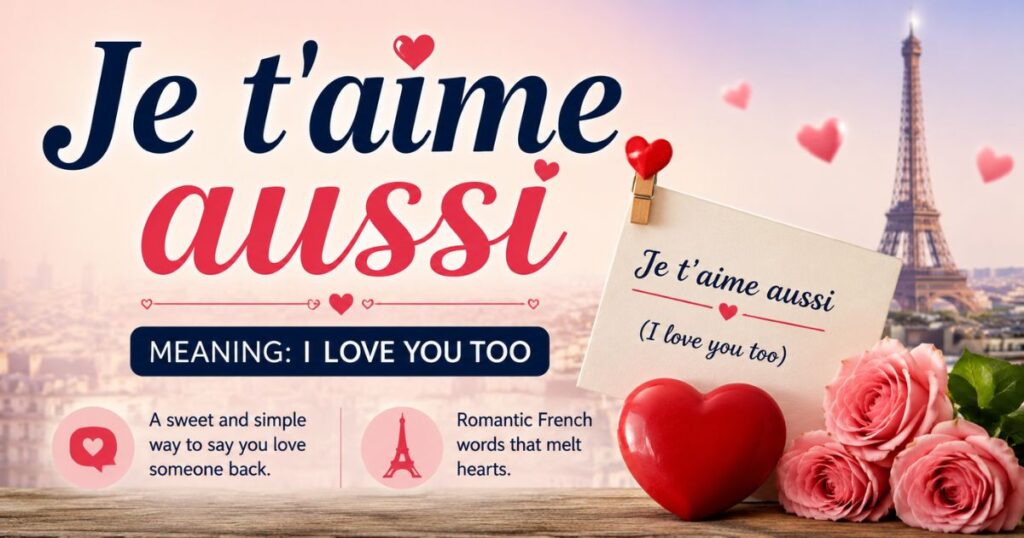
Je t’aime AUSSI means “I love you too.” It’s the direct, simple response when someone says je t’aime and you want to return the sentiment without adding extra words. Moi aussi, je t’aime is a slightly more common phrasing in spoken French, but both are understood and used interchangeably.
Why People Search “Je T’Aime Meaning in Spanish”
This search usually comes from people who’ve heard the phrase in a song, movie, or message and aren’t sure which language it belongs to, since French and Spanish both have romantic reputations online. To be clear, je t’aime is French, not Spanish. The Spanish equivalent is te quiero (a softer “I love you,” often used early in relationships or with family) or te amo (a stronger, more romantic “I love you,” closer in weight to je t’aime).
If a message mixes je t’aime with Spanish words, it’s likely someone blending languages for effect rather than an actual Spanish phrase.
When Je T’Aime Gets Misread
A few situations where meaning gets lost:
- Reading je t’aime bien as a bigger declaration than intended. It’s the opposite; it’s a lighter phrase.
- Assuming je t’aime is casual because “I love you” is casual in English. In French, it usually isn’t.
- Taking silence after saying it personally. Some people freeze up, especially non-native speakers unsure how to respond in French.
- Overusing it early in a relationship. French speakers often build up to je t’aime rather than using it in the first few weeks.
The Short Version of Everything
Je t’aime means “I love you,” but French speakers treat it with more weight than English speakers treat its English counterpart. It’s mainly used between romantic partners and close family, rarely tossed around casually, and easy to misread if you’re not familiar with related phrases like je t’aime bien, which actually means something lighter, not stronger.
If someone says it to you, it’s usually genuine. If you want to say it back, moi aussi, je t’aime or je t’aime AUSSI both work. And if you’re not ready, a warmer non-committal response keeps things honest without shutting the moment down. Once you know these distinctions, the phrase stops being just a pretty-sounding line from a song and starts making real sense.