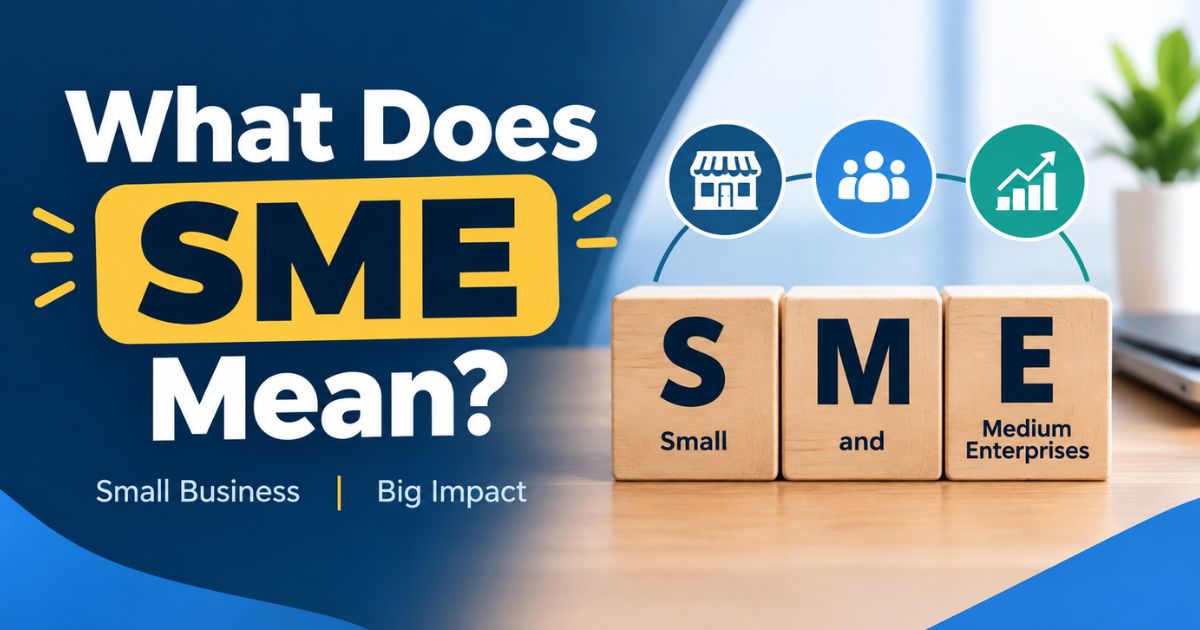

“SME” is an abbreviation of a term that has totally different meanings. Figuring out which of the meanings is appropriate depends only on the context in which you are introduced to the acronym SME.
SME can be a person with expertise or a small business; misunderstanding such concepts causes confusion in most cases.Fortunately for us, knowing the context makes it possible to get rid of any misunderstandings about what the meaning of the acronym is.
SME Quick Meaning
SME is an abbreviation which is very short and means two completely different things. It all depends on the environment in which the abbreviation SME is used.
The SME acronym in a business context means “Small and Medium Enterprise.” The SME acronym in a technical context means “Small and Medium Enterprise.”Both definitions of SME are equally correct.
There is no way but context to find out which of these two is being used. Finance reports generally have the business meaning of SME, while training and technical documents contain the expert meaning.
Business Meaning
SME stands for Small and Medium Enterprise in the context of the business world. SME is a firm that does not reach a particular size level, which may be determined by the number of employees, revenues per year, or both.
The definition varies from country to country, but the core principle remains the same across the world: SMEs are neither large firms nor individuals; rather, they are organizations that conduct their operations as enterprises.
The classification of firms into SMEs is highly important for both governments and banks. Many banks provide specific loan packages for SMEs.
The tax office also may provide specific taxation rates and privileges for SMEs.This classification helps many entrepreneurs obtain grants and other benefits available only to SMEs.
Professional Meaning
The meaning of SME in the context of its usage in the professional environment is “Subject Matter Expert”. This is a person who has a thorough understanding of some specific field, process, software or subject matter.Subject Matter Experts operate in areas requiring high precision.
Subject Matter Experts are frequently seen in fields that require precision. For example, an SME may be used by a software firm to describe a particular function within the application. A hospital may use a medical SME to analyze the clinical processes.
SMEs are valuable because they have profound knowledge about their field, not general business knowledge. They do not have to know everything about the firm; they just have to have extensive knowledge about their specific field.
SME meaning in sales
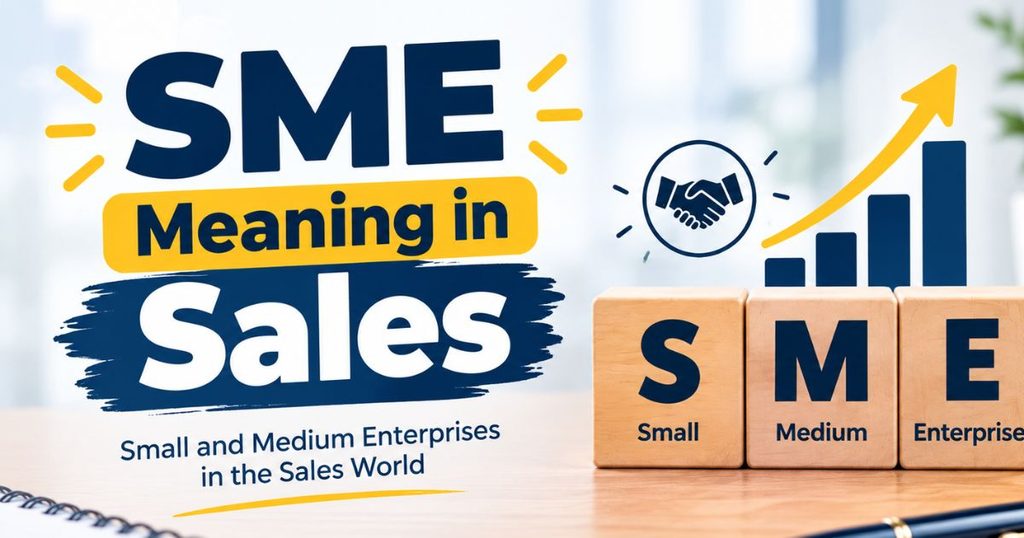
During sales discussions, SME stands for Small and Medium Enterprises because companies segment their customers based on the size of the firm. For instance, a software company will have different price points.
The sales people regularly use the abbreviation during discussions about target market segments. It is very frequent to hear statements like “we are moving into the SME market” and “our product targets the SMEs.”
Alternatively, SME could be used during sales training for the expert definition. This happens especially when the sales team involves an SME for the product to give more insight to the prospective customer on technical issues.
Quoted Examples
“Our new pricing plan is designed for SMEs with fewer than fifty employees.”
“We need an SME from the engineering team to walk the client through the integration process.”
“Government support for SMEs increased significantly this year.”
“Please bring our compliance SME into the conversation before finalizing this document.”
The examples above demonstrate very clearly how the same three letters change their meaning based on the surrounding sentence.
Origin & Background”
The definition of SME goes back many years, and it has its origins in the language of economics and policy because governments required a universal classification system for businesses with regard to taxation and regulation.
The phrase SME arose independently and was used mainly in the areas of business training, military documents, and technical writing.
This explains why these definitions have grown up entirely independent from each other and in entirely different industries.
Real-Life Conversations (Mandatory)
Office project discussion:
- Sarah: “We are stuck at this part of the report. Is there anyone who knows about the tax regulations?” James: “Yes, you can contact Michael. He is our SME for tax compliance.”
Content writing discussion:
- Editor: “The article on medical billing needs to be reviewed by an SME before publishing it.
- ” Writer: “I had already forwarded it to our healthcare SME.”
Sales discussion:
- Client: “Can you explain how your platform manages data encryption?” Sales person: “Sure, this is a good question. I will call our security SME for it.”
Business discussion:
- Manager: “How is our SME loaning program doing for this quarter?” Analyst: “Approvals of SME loans have increased by twelve percent compared to the previous year.”
Project management discussion:
- Project manager: “Before signing off the workflow, we need approval from our SME process.” Team member: “I will arrange a meeting with her.”
SME meaning in project management
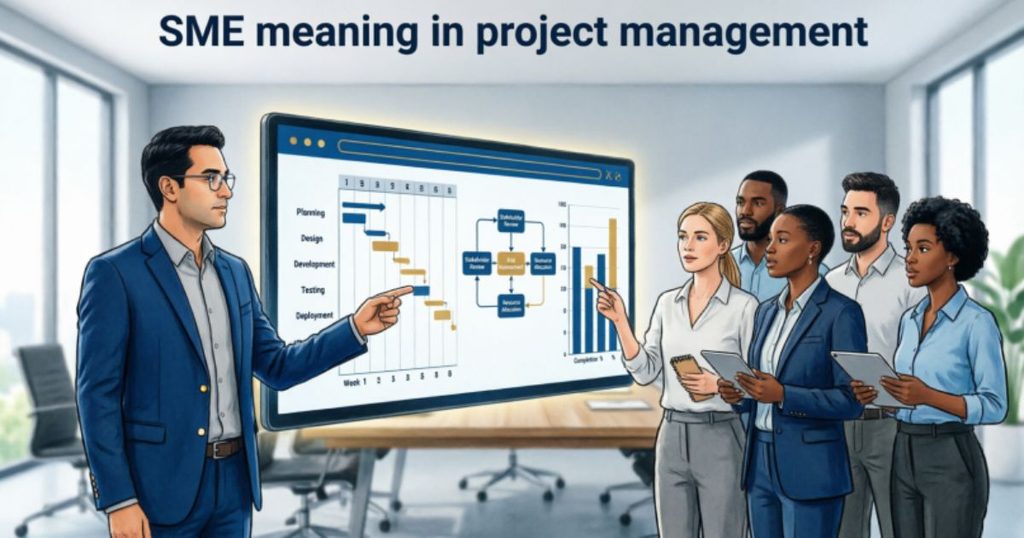
When talking about project management, the term SME refers to the SME .It is the role of the SME to validate the requirements, the technical documentation, and to confirm that the plan is realistic.
The SMEs are normally engaged in certain phases of the project and not necessarily throughout. For example, a project manager may engage the SME during the planning phase to ensure technical feasibility of the project, then again during testing to confirm accuracy.
Also Read This: WDYM Meaning in Texts
Since the SMEs have full-time duties in other areas, their time is precious. Thus, efficient project managers plan the engagement of the SME and ask pointed questions instead of general documentation requests.
Emotional & Psychological Meaning
It goes without saying that when you are called an SME, there must be at least some amount of respect for your knowledge and judgment among your peers.
Getting recognized as an SME gives rise to pride among professionals and helps them gain confidence in their subject knowledge.On the other hand, the SME title can imply a certain degree of pressure on you.
You are expected to always be right because your opinion is vital for the work of your team. You might hesitate answering a question that falls slightly outside the scope of your specialization due to this pressure. In terms of business, being an SME is an emotionally loaded term.
The owner of a small or medium enterprise feels pride for creating something on his/her own, but at the same time he/she has to cope with limited opportunities.
Usage in Different Contexts
Banking: SME lending, SME bank accounts, and SME credit facilities are some typical banking products.
Government policies: SME grants and SME tax incentives promote SME growth.
Training: SMEs assist in the development of correct training courses and certification courses.
Software development: SMEs help define feature sets for developers.
Health care: Clinical SMEs check the correctness of the procedure documentation.
Marketing: Marketing teams can focus their marketing campaigns on SMEs.
Common Misunderstandings
It is assumed by some that SME means the person, whereas in any business context, it almost always means a company. Such assumptions take place, for example, when a beginner hears about it for the first time in his career.
There is another misunderstanding associated with an assumption that an SME has knowledge on any broader subject. In fact, an SME’s expertise is very narrow and specific. An SME might give incorrect information if the question was asked outside his specialization.
It is believed that the term SME is applicable in large corporations only, which is incorrect. In fact, both concepts are used by companies of any size. From startups looking for funds from SME to large corporations contacting SMEs.
Comparison Table
| Feature | SME | SME |
| What does it mean | A knowledgeable individual | A business classification |
| Main area | Technical or specialized knowledge | Company size and revenue |
| Common use | Training, projects, documentation | Banking, policy, sales segmentation |
| Example | “Ask the SME about the software update.” | “This bank offers SME loans.” |
| Main purpose | Provide accurate expert input | Classify businesses for support programs |
| Refers to a person or organization | Person | Organization |
SME meaning in corporate
In the corporate environment, both these meanings come up quite often, even within the same organization. An organization may have its SME unit serving SME customers, but also require SMEs internally to assist in product development.
Corporate presentations commonly highlight the growth strategies of SMEs when talking about market expansion, as SMEs are a major group of customers for banks, software companies, and consultancy organizations.
On the other hand, internal communication within corporations also mentions SMEs, usually referring to SMEs as employees, especially when audits, certifications, or any knowledge transfers are taking place.
Variations / Types of SME (8–10 Minimum)
Technical SME
Concerned with software, system, or engineering information required for writing correct technical documents or solving technical problems.
Cybersecurity SME
Concerned with the protection of information, analysis of threats, and adherence to cybersecurity guidelines.
Healthcare SME
Concerned with clinical accuracy for medical instructional material or medical documentation.
Finance SME
Concerned with accounting or tax information or financial regulation.
Legal SME
Concerned with the review of legal documents like contracts for accuracy.
Product SME
Knowledgeable about the features and usage of a specific product.
Industry SME
Has extensive knowledge on a particular industry, including its trends, laws, and conventions.
Process SME
Concerned with workflows and efficient processes.
Training SME
Concerned with developing training materials and certification.
How to Respond When Someone Uses It

Where SME is used in relation to business, the reply should be based on considerations of firm size, finance, or market segmentation, because in that situation, the person probably means Small and Medium sized Enterprise.
Where SME is used in relation to technology, training, or project management, the reply should be based on considerations of expertise and knowledge because in that situation, the person probably means SME.
In cases where no context exists, it is perfectly fine to seek clarification. The following query may help in such situations “Are you talking about the business or about the expert?”
Regional & Cultural Usage
Small and medium sized enterprises (SME) are terms that are commonly found in government and banking terminologies in most of the English speaking nations, such as the UK. In the US, the term “small business”although SMEs are still mentioned in formal economic and international trade documents.
In Asian countries like India, Singapore, and the Philippines, SME can be found in the business world and in the boardrooms of corporations.
Conclusion
It’s simple; it’s either an SME for a small and medium sized enterprise – depending on the situation and setting in which the word SME is being used – whether in sales, project, or even the banking sector.
Understanding when to apply the context in which the word SME is being used will make understanding the concept quite easy. Apply this handy guide whenever you encounter the term, and you will never have to doubt yourself again.





One thought on “What Does SME Mean? Expert or Small Business Explained Now ”