


Got a message that just says “hru?” and not sure what it means? You are not alone. It is a tiny word, but people often wonder if it is a simple greeting or something more. HRU stands for “How are you?” and it is one of the most common text abbreviations in chats, DMs, and social media comments today.
This guide explains the HRU meaning in text in plain and simple words. You will learn how people use it in real conversations, what it means when a girl sends it, and how to tell if it feels genuine. You will also find easy reply ideas, so you never have to overthink your next message.
What Does HRU Mean in Text?
The HRU meaning in text is simple: “How are you?” People type it when they want to check in with someone. It is quick, friendly, and easy to send.
The letters come from the first letter of each word. H is for “how,” R is for “are,” and U is for “you.” The “U” replaces “you,” which is a habit that started in early text messaging. Back then, every character counted, so short spellings became normal.
Today, the HRU abbreviation is everywhere. You will see it on WhatsApp, Instagram, Snapchat, iMessage, Discord, and Telegram. It shows up in lowercase, uppercase, or with a question mark. “hru,” “HRU,” “Hru?” and “hru??” all mean the same thing.
People often send it as a follow-up. Someone says “Hey, I’m good,” and then adds “hru?” to keep the chat going. Other times, it starts the whole conversation, like “Heyy, hru?”
Here is a quick look at the basics:
| Detail | What to Know |
| Full form | How are you? |
| Type | Text and chat abbreviation |
| Tone | Casual and friendly |
| Where it appears | Texts, DMs, comments, group chats |
| Common spellings | hru, HRU, Hru, hru? |
Now you know the core HRU text meaning. The next part covers how it gets used in daily life.
HRU Most Common Uses at a Glance
HRU is a flexible little word. It can be a greeting, a check-in, or a way to keep a chat alive. The meaning stays the same, but the purpose changes with the moment.
Most people use it in one of these ways:
- As a greeting. “Hey! Hru?” works like saying hello.
- As a follow-up. You answer a question, then ask it back.
- As a check-in. You send it to a friend you have not talked to in a while.
- As a conversation starter. It opens a chat without needing a topic.
- As a caring message. Sent after bad news or a rough day, it shows concern.
- As light flirting. With the right tone, it can show interest.
Here is how each use looks in a real chat:
| Use | Example Message | What It Says |
| Greeting | “Hi! hru?” | Hello, how are things? |
| Follow-up | “I’m good. hru?” | I answered, now you go. |
| Check-in | “Long time. hru?” | I thought of you. |
| Conversation starter | “Heyy hru” | Let’s talk. |
| Support | “I heard about your exam. hru?” | I care how you feel. |
| Flirty | “Hey you, hru today?” | I like talking to you. |
The word is small, so context does most of the work. Who sent it, when they sent it, and how often they text you all shape the real message.
How HRU Is Used in Real Conversations
The best way to understand HRU is to see it in action. Below are a few common chat situations.
A casual chat between friends
Sam: Yo, long time no talk. hru? Ali: All good! Busy with work. hru? Sam: Same here, just tired lol.
This is the classic use. Both people are relaxed. The question opens a friendly back and forth.
A check-in after something difficult
Nina: Hey, I heard the interview didn’t go well. hru? Zoya: Been better, honestly. Thanks for asking.
Here, HRU carries real care. It gives the other person space to share how they feel.
A message from a coworker
Dan: Morning! hru? Did you get the file? Priya: Good morning! I’m well. Sending it now.
At work, HRU is a soft opener before business. It keeps the tone warm.
A message from someone new
Unknown: Hey hru You: Hi! I’m good. Who’s this?
Sometimes HRU comes from a stranger or a new match on a dating app. In that case, it is mostly a polite opener.
In every example, the sender wants a reply. HRU is a question, not a statement. It asks you to respond, so leaving it on read can feel cold to the sender.
HRU Usage at a Glance
This section pulls everything into one place. Use it as a fast reference when you are not sure what to do with an HRU message.
| Situation | Likely Meaning | Best Move |
| Friend sends “hru?” | Friendly check-in | Reply and ask back |
| Family member sends “hru” | Care and concern | Reply with a short update |
| Coworker sends “hru?” | Polite opener | Reply briefly, then move on |
| Crush sends “hru?” | Possible interest | Reply warmly, add a question |
| Stranger sends “hru?” | Basic opener | Reply if you want to chat |
| Ex sends “hru?” | Curiosity or missing you | Take your time, reply if you want |
A few quick points to remember:
- HRU is informal, so it fits casual chats best.
- It always expects an answer.
- Tone, timing, and the sender matter more than the word itself.
- Emojis and extra letters, like “hruuu,” add warmth.
How to Respond to HRU
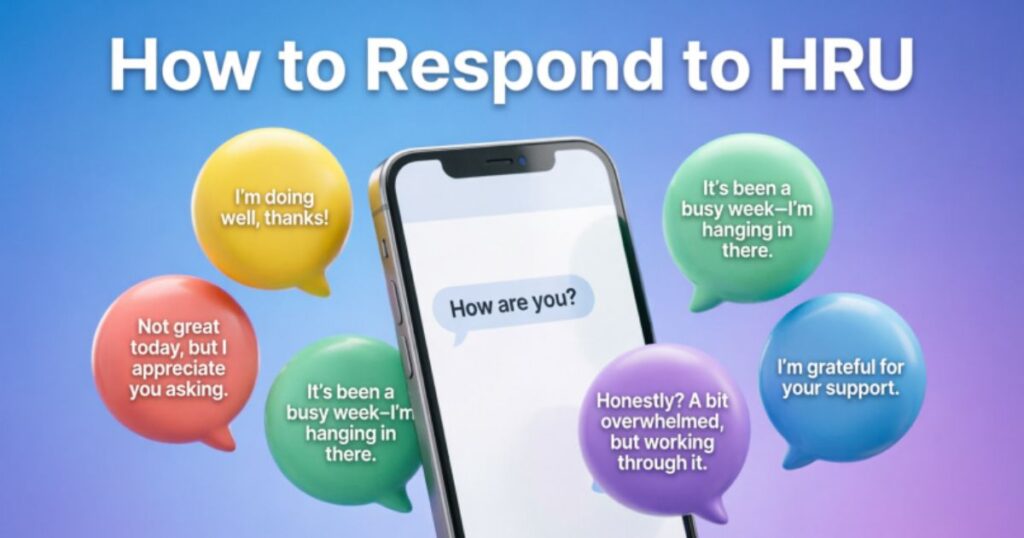
Replying to HRU does not need to be hard. Keep it short, honest, and friendly. Then, if you want the chat to continue, ask the question back.
A good reply has two parts. First, share how you are. Second, return the question with “hbu” or “wbu.”
Here are simple replies for different moods:
| Your Mood | Sample Reply |
| Great | “I’m great, thanks! hbu?” |
| Fine | “Doing good. hru?” |
| Tired | “A bit tired, but okay. wbu?” |
| Busy | “Busy day, but I’m alright. hru?” |
| Not okay | “Not the best day, honestly. hbu?” |
| Playful | “Better now that you texted lol” |
You do not have to say “I’m fine” every time. If you want to be real, say so. Close friends will appreciate it.
Quick tips for replying:
- Answer first, then ask back.
- Match the energy of the sender.
- Keep it short if you are busy.
- Add a small detail to make the chat easier.
For example, “I’m good, just finished dinner. hru?” is better than “good.” It gives the other person something to reply to.
Hru meaning in text reply
When people search for the Hru meaning in a text reply, they usually want to know two things. What should they say back, and what does it mean when someone replies with HRU?
Let’s start with replies. There are three common ways to answer.
1. The simple reply. “Good, hru?” This is quick and works almost every time.
2. The detailed reply. “Pretty good! Just got back from the gym. How about you?” This invites a longer chat.
3. The honest reply. “Honestly, kind of stressed. hru?” This builds trust with people you know well.
Next, consider what it means if someone replies with HRU. Often, you asked them a question, or you started the chat. They answered and tossed it back. That is a sign they want to keep talking.
A reply that only says “hru” with no answer can feel odd. It may mean the person is distracted or busy. Or they might simply be lazy with typing. Do not read too much into it.
Here are a few reply styles and what they tell you:
| Reply | What It Suggests |
| “good hru” | Friendly and quick |
| “I’m good! hru?? tell me everything” | Very interested |
| “Fine. hru” | Neutral or a little flat |
| “hru” (alone) | Distracted or low effort |
| “hru babe” | Close or romantic |
If you are unsure how to reply, be kind and be brief. A friendly answer rarely goes wrong.
Is HRU Genuine or Lazy?
This is a fair question. Some people feel that HRU is a lazy way to say “How are you?” Others think it is warm and casual. The truth sits in the middle.
HRU is a shortcut. It saves time. But a shortcut is not always a sign of low effort. Most people type it because that is how they talk online. It does not mean they do not care.
Still, context matters. Here is how to tell the difference.
Signs that HRU is genuine:
- The sender uses your name.
- It comes after something important in your life.
- They follow up with a real question.
- They reply to your answer with interest.
- The message is not copy and paste.
Signs that HRU may be lazy or low effort:
- It is a one word message with nothing else.
- It comes at random times, with no follow up.
- The sender only texts when they need something.
- They do not react to your reply.
- You get the same message from many people at once.
| Clue | Genuine HRU | Lazy HRU |
| Follow up | Asks more questions | Goes quiet |
| Timing | Fits the moment | Feels random |
| Effort | Adds extra words | Just “hru” |
| Reaction | Responds to your answer | Ignores your answer |
A single “hru” is not a red flag. Look at the pattern over time. If someone always checks in and listens, they care. If they vanish after your reply, the message was probably just filler.
HRU vs Similar Abbreviations
HRU is not the only short check-in. Many similar abbreviations look alike but mean different things. Mixing them up can lead to awkward replies.
Here is a clear comparison:
| Abbreviation | Full Form | Meaning | Example |
| HRU | How are you? | Asks about your general state | “hru?” |
| HBU | How about you? | Returns a question back to someone | “I’m good, hbu?” |
| WBU | What about you? | Same as HBU | “Tired, wbu?” |
| WYD | What are you doing? | Asks about your current activity | “wyd rn?” |
| HAY | How are you? | Another short form of HRU | “hay?” |
| WYA | Where are you at? | Asks where you are | “wya?” |
| SUP | What’s up? | Casual greeting | “sup” |
| HMU | Hit me up | Asks you to contact them | “hmu later” |
The biggest mix up is between HRU and WYD. HRU asks about how you feel. WYD asks about what you are doing at that moment. So “hru?” gets a mood answer, like “good” or “tired.” “wyd?” gets an activity answer, like “watching TV” or “at work.”
HBU and WBU are also easy to confuse with HRU. They are follow-ups. You use them after you have already answered. HRU can open a chat, but HBU usually cannot.
Here is a simple way to remember the group:
- HRU asks how you are.
- HBU and WBU bounce the question back.
- WYD asks what you are doing.
- WYA asks where you are.
- SUP is a general hello.
Once you learn this small set, most texts become much easier to read.
What Does It Mean When a Girl Sends HRU?
This is one of the most searched questions about the term. People want to know if a message from a girl carries a hidden meaning.
The honest answer is that it depends. There is no single rule. A girl who sends “hru” could be a friend, a classmate, a coworker, a relative, or someone who likes you. The word itself does not tell you.
Also Read This: BFF Meaning in Text
Most of the time, she is just being friendly. It is a normal way to start or continue a chat. Many people send it to everyone they know.
But there are cases where it may show extra interest. Look at the whole picture, not only the letters.
Possible meanings when a girl sends HRU:
- She wants to chat and has nothing specific to say.
- She is checking in because she cares.
- She is being polite after meeting you.
- She is interested in you and testing the water.
- She is continuing a conversation after your message.
Do not assume romance from one text. Read the pattern.
Hru meaning in text from girl

Now let’s look at the Hru meaning in text from girl more closely. The clues are in her tone, timing, and effort.
| Clue | May Show Friendly Interest | May Show Romantic Interest |
| Timing | Sent during the day | Sent late at night or often |
| Extra words | “hru?” | “hru today? I missed talking to you” |
| Emojis | Simple smile | Hearts, winks, or blushing faces |
| Follow up | Short chat | Long, detailed chat |
| Frequency | Now and then | Almost every day |
| Personal questions | Few | Many |
If she texts first, remembers small details, and asks about your day, she may like you. If she only sends “hru” once in a while, she is likely just being nice.
Here are a few examples of how the same word can feel different:
- “hru” sent alone at 2 pm: probably casual.
- “hru?? I was thinking about you” sent at night: likely romantic.
- “hru, did the presentation go well?” sent after an event: caring and attentive.
What should you do?
Reply naturally. Answer her question and ask one back. If she keeps the chat going, that is a good sign. If the chat fades, it was probably just polite.
Avoid overthinking. If you want to know how she feels, the best way is to talk to her, in person or in a clear message.
When to Use HRUAnd When Not To
HRU is handy, but it is not right for every chat. Knowing when to use it helps you sound natural and polite.
Good times to use HRU:
- Texting friends and family.
- Starting a chat with someone you know well.
- Checking in after a long gap.
- Following up after bad news.
- Replying to a casual greeting.
- Chatting on social apps and DMs.
Times to avoid HRU:
- Formal emails to a boss, teacher, or client.
- Job applications and cover letters.
- Official or legal messages.
- Condolence notes to someone you barely know.
- Messages to older relatives who may not know slang.
| Setting | Use HRU? | Better Option |
| Chat with a friend | Yes | “hru?” |
| Group chat | Yes | “hru guys?” |
| Message to a coworker you know | Sometimes | “How are you?” |
| Email to a manager | No | “I hope you are well.” |
| Job application | No | “Dear Hiring Manager,” |
| Message to a grandparent | Maybe not | “How are you, Grandma?” |
A simple rule helps. If you would not use slang in the same setting when speaking, do not use HRU in writing. When in doubt, write the full words. It takes only a second and looks more polished.
Conclusion
HRU means “How are you?” It is a short, friendly way to check in with someone over text. You will see it in casual chats, DMs, and social apps, and it works as a greeting, a follow-up, or a caring question.
The meaning is easy, but the context matters. A message from a friend, a coworker, or a girl you like can carry different feelings. Look at the timing, tone, and effort behind the message. Reply kindly, be honest, and ask the question back. Save the abbreviation for casual talk, and use full words in formal writing.





One thought on “HRU Meaning in Text: What It Really Means and How to Reply”