
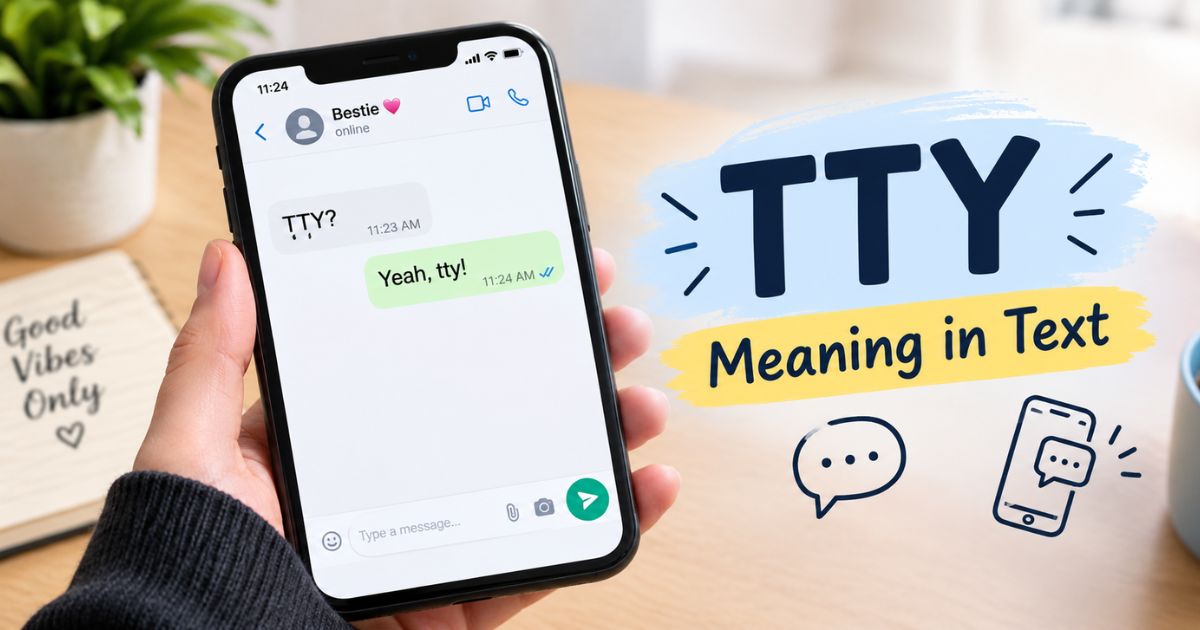

You may have seen “TTY” pop up in a chat and wondered what it meant. It looks short and simple, but it can confuse people who are new to texting slang. The good news is that it is easy to learn.
This guide explains what TTY means, where it comes from, and how to use it the right way. You will also see real examples, common mistakes, and a few tips to help you sound natural when you chat.
Quick Answer
TTY stands for “talk to you.” People use it to say they will speak to someone soon. It is often used to end a chat or to plan a later conversation.
Here is a quick look:
- Full form: Talk to you
- Type: Texting abbreviation
- Tone: Casual and friendly
- Most common use: Ending a chat or planning to talk later
- Where it appears: Text messages, DMs, and social media comments
A simple example: “I have to go now. TTY tonight!”
What Does “TTY” Mean in Text?
In text, TTY is short for “talk to you.” It is a quick way to say you plan to connect with someone again. The talk can happen through a call, a message, or a face-to-face chat.
Most of the time, TTY is used as a goodbye. It works a lot like saying “see you later,” but it focuses on talking instead of meeting. It tells the other person that the conversation is not over for good.
It often comes with a time. For example, “TTY later,” “TTY tomorrow,” or “TTY soon.” The time part makes the message clear and friendly.
What Does “Talk to You” Mean in Simple Words
“Talk to you” simply means “I will speak with you again.” It is a light promise. It is not a strict plan, and nobody expects an exact time unless one is given.
Think of it like waving goodbye. You are not saying a heavy farewell. You are only saying that you will be in touch.
Here is how the phrase changes with a small word added:
| Phrase | Simple Meaning |
| TTY | I will talk to you |
| TTY soon | I will talk to you in a short while |
| TTY later | I will talk to you at some point today |
| TTY tomorrow | I will talk to you the next day |
| TTY tonight | I will talk to you this evening |
Why People Use “TTY” in Texting
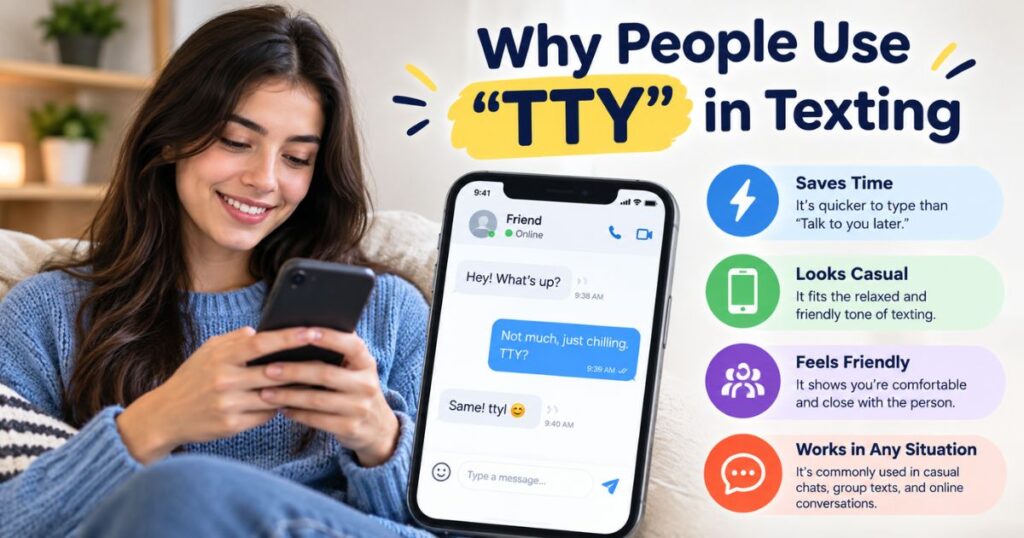
People love short words when they type. Texting is fast, and small screens make long sentences tiring. TTY saves time and effort.
There are a few main reasons people choose it:
- It is quick. Three letters are easier than three words.
- It feels friendly. It keeps the chat warm and relaxed.
- It ends chats gently. It avoids an awkward, sudden stop.
- It is easy to remember. The letters match the words directly.
Another reason is habit. Once friends use a short form, everyone starts using it. It becomes part of how your group talks.
Is “TTY” Formal or Informal?
TTY is informal. It belongs in casual chats with friends, family, and people you know well. It is not meant for serious or professional messages.
You would not write it in a job application or a business email. It could look careless or too relaxed. In those cases, it is better to write “I will talk to you soon” in full.
Here is a simple guide:
| Situation | Is TTY Okay? |
| Chat with a close friend | Yes |
| Message to a family member | Yes |
| Comment on social media | Yes |
| Text to a coworker you know well | Maybe |
| Email to a boss or client | No |
| Official letter or report | No |
TTY meaning in phone
On a phone, TTY can mean two different things. This is where many people get mixed up.
In a text message, TTY means “talk to you.” This is the meaning most people use every day.
In phone settings, TTY means “teletypewriter.” It is a tool built for people who are deaf, hard of hearing, or have speech difficulties. It lets them send typed text during a phone call instead of using voice. Many phones have a “TTY mode” in the accessibility menu.
So how do you know which one someone means? Look at the situation. If a friend types “TTY later” in a chat, they mean “talk to you later.” If you see “TTY mode” in your settings, it is the accessibility feature.
How to Use “TTY” Correctly in Sentences
Using TTY is easy. You can place it at the end of a message, at the start, or on its own. The key is to keep the tone casual.
Here are the most common ways:
- At the end of a message: “Heading out now, TTY later.”
- With a time: “Busy today. TTY tomorrow!”
- With a reason: “Class is starting. TTY after.”
- As a quick reply: “Ok, TTY.”
- With a friendly note: “Thanks for the help! TTY soon.”
Try not to use it in the middle of a long, serious sentence. It sounds odd there. Keep it short and place it where a goodbye would normally go.
Also remember that TTY refers to a future chat. You would not say “We had a great TTY yesterday.” That is not how the term works.
Common Situations Where People Use “TTY”
People use TTY in many daily moments. Most of them involve a pause or a goodbye.
Here are the most common ones:
- Leaving a chat to do something else. You might be going to eat, study, or work.
- Going to sleep. A quick “Good night, TTY tomorrow” is common.
- Being busy. You may not have time to reply fully right now.
- Making a loose plan. You want to say you will call or message later.
- Ending a long conversation. It gives a soft and friendly finish.
- Replying to a plan. Someone says they will call you, and you answer “Sounds good, TTY.”
In all of these, TTY keeps things simple. It says a lot with very little.
Real-Life Examples of “TTY” in Conversations
Seeing the term in action makes it easier to understand. Here are a few short chats.
Example 1: Ending a chat with a friend
- Sam: “I need to go to practice.”
- Jake: “No problem. TTY after!”
- Sam: “Yep, later.”
Example 2: Saying goodnight
- Mia: “I am so tired. Heading to bed.”
- Lina: “Sleep well. TTY tomorrow.”
Example 3: Being busy at work
- Omar: “Can you talk now?”
- Ali: “In a meeting. TTY at lunch.”
Example 4: Making a plan
- Sara: “I will call you tonight.”
- Noor: “Great, TTY then.”
Example 5: On social media
- A comment on a post: “Loved your video! TTY soon.”
You can see the pattern. TTY is short, kind, and points to a future chat.
When You Should Avoid Using “TTY”
TTY is handy, but it does not fit everywhere. There are moments when you should skip it.
Avoid it in these cases:
- Professional emails. Write the full phrase instead.
- Serious talks. If someone is upset or sharing bad news, a short abbreviation can feel cold.
- With people who may not know it. Older relatives or new contacts may get confused.
- In formal writing. School papers, reports, and letters need full words.
- When you do not plan to talk again. It may give a false promise.
Think about your reader. If they might not understand, or if the topic is serious, use full words. Clear communication matters more than speed.
Also Read This: HBU Meaning in Text
Tty meaning in text from a girl
When a girl sends you “TTY,” the meaning is still “talk to you.” It does not have a secret code behind it. Most of the time, she is simply ending the chat in a friendly way.
The tone depends on the rest of the message. Here is how to read it:
| What She Writes | Likely Meaning |
| “Gotta go, TTY later!” | Friendly goodbye, she will message you later |
| “TTY soon :)” | Warm tone, she is happy to keep talking |
| “Busy right now, TTY.” | She is occupied and will reply when free |
| “Ok. TTY.” | Short reply, may be neutral or a bit dry |
Do not read too much into it. One short word does not show deep feelings. Look at how often she messages you, her other words, and her emojis. Those give a better clue than TTY alone.
If you want to know more, you can simply ask. A polite message like “Sure, talk to you later! Have a good day” keeps things easy and friendly.
Common Mistakes People Make with “TTY”
Even a small abbreviation can be misused. Here are the mistakes people make most often.
- Mixing it up with TTYL. These are close, but not the same. TTYL adds “later.”
- Using it in formal messages. It looks too casual for work.
- Forgetting the accessibility meaning. In phone settings, it means something else.
- Using it for the past. TTY points to the future, not what already happened.
- Overusing it. Ending every message with TTY can feel repetitive.
- Assuming everyone knows it. Some people may need a quick explanation.
A small tip: if you are unsure, write the full phrase. Nobody will mind, and your message will be clear.
Similar Slang Terms Like “TTY” in Texting
TTY is one of many short goodbye terms. Here are others you may see.
| Slang | Full Form | Meaning |
| TTYL | Talk to you later | Talk later today or soon |
| TTYS | Talk to you soon | Talk again shortly |
| TTYT | Talk to you tomorrow | Talk the next day |
| BRB | Be right back | Gone for a moment |
| G2G | Got to go | Leaving now |
| GTG | Got to go | Leaving now |
| L8R | Later | See or talk later |
| BBL | Be back later | Returning after a while |
| CYA | See you | Goodbye |
| TTFN | Ta-ta for now | Playful goodbye |
These all serve the same purpose. They help you wrap up a chat without typing a long sentence. Some feel more casual or playful than others.
TTY vs TTYL vs BRB: Key Differences Explained
These three are often mixed up because they all appear at the end of chats. Still, each one has its own job.
TTY means “talk to you.” It is general. It does not say when.
TTYL means “talk to you later.” It adds a sense of time. It suggests a chat will happen later, but not right away.
BRB means “be right back.” It is very different. It says you are stepping away for a short time and will return to the same chat soon.
Here is a clear side-by-side look:
| Feature | TTY | TTYL | BRB |
| Full form | Talk to you | Talk to you later | Be right back |
| Time length | Not fixed | Later | Very short |
| Chat ending? | Often yes | Yes | No, only a pause |
| Best use | General goodbye | Ending a chat for now | Short break |
| Example | “TTY tonight” | “Busy, TTYL” | “BRB, phone ringing” |
A simple way to remember: TTY and TTYL end a chat. BRB only pauses it.
How People Use “TTY” on Social Media Platforms
TTY also shows up on social apps. The use is a bit different there, because chats are often public or spread across many people.
On Instagram and Snapchat, people use it in DMs to end a chat with friends. It is common with quick replies and stories.
On WhatsApp and Messenger, it works like regular texting. Friends drop it at the end of a message before logging off.
On TikTok and YouTube, it may appear in comments. A creator might write “Thanks for watching, TTY in the next video.” Fans might also use it to say they will chat again.
On X (Twitter) and Facebook, users sometimes use it in replies to end a thread politely.
On gaming chats like Discord, players use it when they leave a voice or text room. For example, “Good game, TTY tomorrow.”
In every case, the meaning stays the same. Only the setting changes.
TTY for Beginners: Simple Explanation
If you are new to texting slang, here is the easiest way to think about TTY.
Imagine you are leaving a friend’s house. You say, “Talk to you soon!” TTY is just that sentence made shorter for your phone.
Here is a step-by-step way to learn it:
- Remember the words. T is for Talk, T is for To, Y is for You.
- Know when to use it. Use it when you are ending a chat.
- Add a time if you like. Words like “later” or “tomorrow” help.
- Keep it casual. Use it with friends and family.
- Practice. Try it in your next chat.
That is all it takes. You do not need to memorize complicated rules.
Comparison Table: TTY Meaning in Different Contexts
The meaning of TTY changes based on where you see it. This table clears up the differences.
| Context | What TTY Means | Example |
| Text message | Talk to you | “Going out. TTY later.” |
| Social media DM | Talk to you | “Have to log off. TTY soon.” |
| Social media comment | Talk to you | “Great post! TTY again soon.” |
| Phone accessibility settings | Teletypewriter | “Turn on TTY mode.” |
| Deaf or hard-of-hearing communication | Text-based phone device | “She uses a TTY to make calls.” |
| Casual chat with a girl or boy | Talk to you | “Sleepy now, TTY tomorrow.” |
| Workplace chat | Talk to you (informal) | “Stepping out, TTY after lunch.” |
If you are ever unsure, check the setting and the tone. That usually gives you the answer.
Tips to Use “TTY” Correctly in Conversations
A few simple habits will help you use TTY well.
- Know your audience. Use it with people who understand slang.
- Add a time. “TTY tonight” is clearer than plain “TTY.”
- Pair it with a kind word. “Thanks, TTY soon!” sounds warm.
- Do not overuse it. Mix it up with other goodbyes.
- Skip it in formal writing. Write the full phrase there.
- Keep your promise. If you say you will talk soon, try to follow through.
- Watch the tone. A short “Ok. TTY.” can sound cold. Add a smile or a friendly word.
- Use full words when needed. Clear is better than fast.
These small steps make your messages feel natural and considerate.
Why Understanding “TTY” Improves Your Communication
Knowing common abbreviations helps you follow chats without confusion. You will not miss the meaning of a message or reply in the wrong way.
It also makes you a better chatter. You can end conversations politely, match the tone of your friends, and save time. People notice when you understand their style, and it builds a stronger connection.
There is a bigger lesson too. Language keeps changing, and texting terms are part of that change. When you learn small ones like TTY, you become more comfortable with all the others. That makes online talk feel easier and friendlier.
Finally, knowing when not to use slang is just as useful. It shows respect for the person you are talking to. Good communication is about being clear, kind, and suited to the moment.
Final Thoughts
TTY is a small term, but it does a useful job. It helps you say goodbye without sounding stiff, and it keeps a chat warm. Once you understand its meaning, you will spot it everywhere and know exactly how to reply.
Use it the right way and it will make your messages faster and friendlier. When the situation is serious or formal, choose full words instead. That simple balance will keep your texting clear, polite, and natural.





One thought on “TTY Meaning in Text: What It Means and How to Use It Right”