

TW most often means trigger warning. It is a short heads-up that tells people the next message, post, or video may include upsetting content.
You will see it in texts, captions, comments, and group chats. It usually shows up right before something heavy, like a story about loss, violence, or health struggles.
Think of it as a polite pause. The sender is saying, “Hey, this next part might be hard to read. Your call if you want to continue.”
The warning does not mean the content is bad. It just gives the reader a choice. That is the whole point.
Here is a quick snapshot:
| Term | Full Form | Quick Meaning |
| TW | Trigger Warning | A heads-up about sensitive content |
| Common Style | tw: topic | The topic is named after “tw” |
| Typical Tone | Caring and respectful | Gives readers a choice |
Simple Meaning (In Case You Still Have Questions)
Let’s keep it very simple. TW stands for trigger warning. A trigger warning is a note that says, “Sensitive topic ahead.”
A “trigger” is something that can bring back painful memories or strong feelings. This could be a loud scene in a movie, a news story, or a detailed description of an accident.
When someone types “TW,” they are not trying to scare you. They are trying to protect you. They want you to be ready, or to skip the post if you need to.
So if a friend texts, “TW: car accident,” they mean the next message talks about a car accident. You can read it, or you can wait until you feel ready.
That is all there is to it. Short, kind, and useful.
Where Is TW Used?
TW can show up almost anywhere people share words online. Some places use it more than others.
Here are the most common spots:
- Text messages: Friends use it before sharing a hard story or a serious update.
- Instagram: Captions, Stories, and comments often start with TW.
- TikTok: Creators add it in captions or on screen before heavy videos.
- X (Twitter): Users put it at the start of a post or thread.
- Tumblr and Reddit: Both have a long habit of using content warnings.
- Group chats and Discord: Members use it to keep chats comfortable.
- Blogs and fan fiction sites: Writers list warnings before a story begins.
It is also used in schools and online support groups. Some teachers give a short warning before they talk about a heavy topic in class.
The format is almost always the same. The letters TW come first. Then the topic follows, often after a colon.
For example: TW: medical talk. Or: tw // loss of a loved one.
Why Do People Use TW?
People use TW because they care. It is a small act of kindness that takes two seconds to type.
Some topics hit people harder than others. A post that feels normal to one person can feel heavy to someone else. A warning gives everyone a fair chance to decide for themselves.
Here are a few common reasons people add it:
- To protect readers who may have lived through something painful
- To avoid surprising people with upsetting details
- To show respect in a group chat or comment section
- To let people read at a good time, when they feel steady
- To follow the rules of a page, group, or community
There is another simple reason. It builds trust. When you warn people, they feel you thought about them before you hit send.
Some people also use TW because a platform or group asks them to. Many online spaces expect a warning for certain topics.
TW meaning in instagram
On Instagram, TW still means trigger warning. It works the same way as it does in text messages.
You will often see it at the top of a caption. A creator might write, “TW: food and body talk,” and then share their post. This lets followers scroll past if they want to.
It also appears in Stories. Someone might add a text sticker that says “TW” before a video or photo. Some people also use the blur or “sensitive content” cover so the image stays hidden until a tap.
In comments, people sometimes reply to a post with, “Please add a TW for this.” That is a gentle request, not an attack. It just asks the creator to add a heads-up.
Here is how it often looks on Instagram:
| Where | Example | What It Does |
| Caption | “TW: grief and loss” | Warns before the text |
| Story | Text sticker saying “TW” | Warns before the clip |
| Comment | “Could you add a TW?” | Politely asks for a warning |
| Bio | “I post about heavy topics, TW in captions” | Sets expectations |
One more tip. Many creators put the warning first, before any photo or hook. That way, no one reads the sensitive part by accident.
Real-Life Examples Of TW In Action
Seeing real examples makes everything clearer. Here are some everyday situations.
Example 1: A text between friends
Maya: TW: hospital stuff. Can I tell you what happened with my dad today? Sam: Of course. I’m here. Go ahead.
Maya warns Sam first. Sam gets to say yes. That small step makes the talk smoother.
Example 2: An Instagram caption
TW: mention of a car crash. I finally feel ready to share my story. Thank you for being kind.
Followers who are not ready can scroll by. Followers who want to read can continue.
Example 3: A group chat
Leo: tw // news about a natural disaster Priya: Thanks for the heads up. I’ll read it later tonight.
Priya feels respected. She picks her own time.
Example 4: A TikTok caption
tw: loud noises and flashing lights
Here, the warning is not about emotions. It is about a physical reaction some viewers might have, like discomfort from flashing lights. Many creators add it for this reason too.
Example 5: A school or study group
Ava: TW: we’re about to discuss a heavy historical event in our project. Anyone need a break first?
Ava checks in before the talk. It keeps the group comfortable.
Example 6: A casual, light use
Jordan: TW: I’m about to rant about my terrible commute.
Some people use TW as a joke. They add it before something silly, like a rant or a hot take. It is playful, not serious. Context tells you which one it is.
TW vs Similar Terms What’s The Difference?
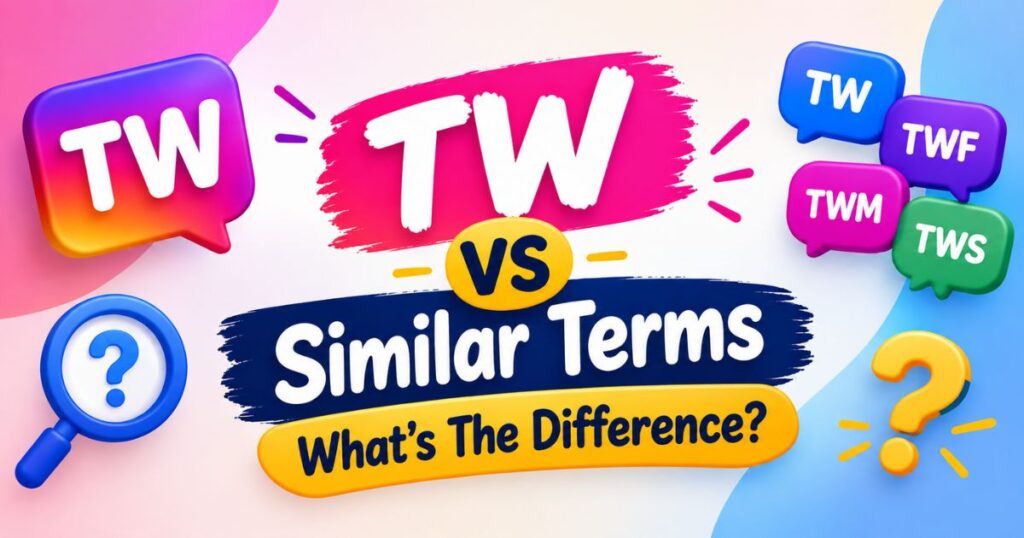
TW is part of a family of internet warning and heads-up terms. They look alike, but they do different jobs.
Let’s break them down.
- TW (Trigger Warning): A heads-up about content that may upset someone.
- CW (Content Warning): A broader warning. It covers any content someone might want to avoid.
- NSFW (Not Safe For Work): A label for adult or explicit content that is not suitable at work or in public.
- Spoiler Warning: A note that you are about to reveal a plot twist or ending.
- FYI (For Your Information): A casual note that shares useful info. It is not a warning.
- PSA (Public Service Announcement): A message meant to inform or help people, often about safety or common problems.
Here is a side-by-side look:
| Term | Full Form | Main Purpose | Example |
| TW | Trigger Warning | Warn about upsetting topics | “TW: loss of a pet” |
| CW | Content Warning | Warn about any sensitive content | “CW: flashing lights” |
| NSFW | Not Safe For Work | Flag adult or explicit material | “NSFW: adult humor” |
| Spoiler Warning | Spoiler Warning | Protect plot details | “Spoilers for the finale” |
| FYI | For Your Information | Share helpful info | “FYI, class starts at 9” |
| PSA | Public Service Announcement | Inform or protect people | “PSA: Check your tire pressure” |
TW vs CW: These two are very close. Many people use them in the same way. Some say CW is wider, because it can cover topics that are not about trauma. TW is more focused on content that could trigger a strong reaction.
TW vs NSFW: NSFW is about what is appropriate at work or in public. TW is about emotional safety. A post can be NSFW without needing a TW. A post can also need a TW without being NSFW.
TW vs Spoiler Warning: A spoiler warning only protects the fun of a story. A TW protects feelings and wellbeing. They solve different problems.
Also Read This: HBY Meaning in Text
TW vs FYI and PSA: FYI and PSA are not warnings about sensitive content. They share facts or advice. You would not use FYI to say a topic might upset someone.
When Should You Use TW?
Use TW any time you think your message might upset a reader. When in doubt, add it. It costs almost nothing.
Here are common cases where a warning helps:
- Death, grief, or serious loss
- Accidents, injuries, or violence
- Medical stories, hospital visits, or health scares
- Abuse, harassment, or unsafe situations
- Food and body talk, such as dieting
- Natural disasters, wars, or tragic news
- Mental health struggles
- Flashing lights, loud sounds, or graphic images
Timing matters too. Place the warning before the sensitive part, not after. A warning that comes late is not much help.
You do not need a TW for everyday chat. Talking about your lunch or your weekend plans does not need one. Save it for the moments that call for it.
If you are not sure, think about your audience. A close friend may be fine with a quick “heads up.” A big public audience may include many people with different backgrounds. In that case, a clear warning is a good idea.
TW meaning gen z
For Gen Z, TW still means trigger warning. But the way it is used has grown.
Gen Z grew up online, where people share a lot. Because of that, warnings feel like normal good manners. Many young people add a TW without thinking twice.
You will often see it in lowercase. Something like “tw” or “tw //” followed by the topic. It looks casual, but the care behind it is real.
Gen Z also plays with the term. Some use it as a joke before a silly or dramatic post. For example, “tw: my cooking” before a photo of burnt toast. Everyone gets the joke.
Here is how the tone can shift:
| Use | Example | Tone |
| Serious | “tw: grief” | Caring |
| Light | “tw: I ate three pizzas” | Funny |
| Sarcastic | “tw: my terrible singing” | Playful |
| Practical | “tw: flashing lights” | Helpful |
The trick is reading the room. If the topic is heavy and the tone is gentle, it is a real warning. If the topic is silly and the tone is jokey, it is a joke.
One more note. Some people feel the joking use waters down the real meaning. Others think it is harmless fun. It is fair to be thoughtful about when you use it that way. If you are talking to someone going through a hard time, skip the jokes.
Common Misunderstandings About TW
TW is simple, but a few myths keep popping up. Let’s clear them up.
Myth 1: TW always means trigger warning. Most of the time, yes. But not always. In some places, TW can mean other things. It depends on the chat and the people in it.
Here are a few other meanings you might see:
| Meaning | Where You Might See It |
| Taiwan | Country codes, travel, and shipping |
| Tweet | Older social media talk, sometimes “tw” for Twitter |
| This Week | Work notes or planning lists, like “TW vs LW” |
| Team Work | Some school or office settings |
Always look at the words around it. A message like “TW: abuse” is clearly a warning. A message like “shipping to TW” is about Taiwan.
Myth 2: A TW means the content is dangerous or bad. No. It only means the content may be sensitive. Many great stories and posts carry a TW.
Myth 3: People who use TW are being dramatic. Not true. A warning takes one second and can help someone a lot. It is a kind choice, not a show.
Myth 4: A TW protects you from all criticism. It does not. A warning is a courtesy. It does not make hurtful or unkind content okay.
Myth 5: TW and CW are totally different. They are very close. Many people use them as twins. The small difference is mostly about how wide the warning is.
Myth 6: Using TW is only for serious topics. It started that way. These days, some people also use it in a joking way. Just be sure your audience will get the joke.
Pro Tips For Using TW The Right Way
Want to use TW well? Follow these easy tips.
- Put it first. Place the warning before the sensitive content. Do not hide it at the end.
- Name the topic. A clear label helps most. “TW: car accident” is better than just “TW.”
- Keep it short. You do not need a long note. A few words are enough.
- Stay specific, not graphic. Name the topic without adding painful details in the warning itself.
- Match your tone. Be gentle for serious topics. Save jokes for light moments.
- Use spacing when you can. On social media, add a few blank lines or a cover before the content. This keeps the text hidden until people choose to read.
- Respect requests. If someone asks you to add a TW, try to do it. It shows you care.
- Do not overuse it. If you add it to every post, people may stop noticing it. Use it when it counts.
- Think about your audience. A close friend may need less. A big public page may need more.
- Check in after, too. If you shared something heavy in a chat, ask how people are doing. A small check-in goes a long way.
Here is a simple format you can copy:
TW: [topic] (A little space) Your message starts here.
Small habits like these make online spaces feel safer and kinder.
Final Thoughts
TW means trigger warning, and it is one of the kindest short forms online. It gives people a chance to prepare, or to skip a post when they need to. It works in texts, on Instagram, on TikTok, and in group chats. For Gen Z, it is simply part of everyday good manners.
Use it when a topic might hit hard. Put it first, name the topic, and keep it short. And when you see TW in a message, take it as a gentle note from someone who cares about your comfort. A tiny warning can make a big difference.


One thought on “TW Meaning in Text: What It Really Means on Instagram 2026”