

You have probably seen “PPM” on a water report, a work email, or a printer box. It looks small. But it can mean very different things depending on where you see it.
If you have ever typed “what does PPM mean” into a search bar, you are not alone. The short answer is that PPM most often stands for parts per million. It is a way to show tiny amounts of one thing inside a much bigger whole.
This guide explains the PPM meaning in plain words. You will learn the PPM definition, the main PPM uses, real chat examples, and how to reply when someone uses the term. Let’s start simple.
PPM Meaning Quick Explanation
PPM usually means parts per million. It tells you how many parts of a substance exist in one million parts of a mixture. Think of it as a very small slice of a very large pie.
Here is the quick version:
- Most common meaning: parts per million
- Where you see it: water tests, air quality, chemistry, food safety, farming, manufacturing
- Simple math: 1 ppm = 1 part in 1,000,000 parts
- As a percent: 1 ppm = 0.0001%
Some people picture it like this. One ppm is about one drop of ink in a large bathtub of water. It is also about one second in nearly 12 days.
The term also has other meanings in offices, factories, film sets, and tech. We will cover those below. For now, remember this: if the topic is science or measurement, PPM almost always means parts per million.
Origin & Background of PPM
The idea behind PPM is old and practical. As science and industry grew, people needed a way to talk about very small amounts. Percent works well for big shares. It is clumsy for tiny ones. Saying “0.0003 percent” is harder than saying “3 ppm.”
So scientists and engineers started using parts per million. It is easy to say. It is easy to compare. And it fits well with things like pollutants, minerals, and trace gases.
Over time, the term spread far beyond the lab. Water utilities, farmers, pool owners, and factory managers all began to use it. Today, you can find ppm on a bottle of plant food or a home air monitor.
The letters “PPM” also grew other meanings. Different fields borrowed the same short form for their own needs. That is why one acronym can point to a science term in one place and a business term in another.
Note on style: in science, the unit is usually written in lowercase as “ppm.” In everyday writing, people often use capital letters. Both are fine for readers.
Real-Life Conversations Using PPM (Mandatory Examples)
Real chats show the PPM meaning better than any definition. Here are common scenes.
Example 1: A text between friends
- Sam: The pool guy said my chlorine is at 2 ppm. Is that good?
- Lena: Yes. Most pools sit around 1 to 3 ppm. You are fine.
Example 2: A workplace message
- Maya: Can you join the PPM meeting at 3 pm?
- Omar: Sure. Is that the project portfolio one?
- Maya: Yes. We are ranking next quarter’s projects.
Example 3: A home water test
- Dad: The TDS meter says 240 ppm.
- Zara: What does PPM mean here?
- Dad: Parts per million of dissolved solids. It is a normal number for drinking water.
Example 4: An office printer
- Ali: This printer does 30 PPM.
- Nina: So it prints 30 pages per minute. That is fast enough for our team.
Example 5: A film crew chat
- Director: We have the PPM tomorrow at ten.
- Assistant: Pre-production meeting. Got it. I will bring the shot list.
Example 6: A confused text
- Jake: Just got an email that says “check PPM before Friday.”
- Ravi: Which team sent it? PPM could mean a few things. Ask them to spell it out.
Notice the pattern. The meaning is clear once you know the setting. When the setting is unclear, a quick question saves time.
Emotional & Psychological Meaning of PPM
PPM is a technical term. It does not carry feelings by itself. But people do react to it, and those reactions are worth understanding.
Numbers with ppm can feel scary. A water report that lists a chemical at “5 ppm” may sound alarming. In truth, the number means little until you compare it with a safe limit. Fear often comes from not knowing the scale.
The term can also create a feeling of being left out. Imagine you join a new job. Everyone says “PPM” in every meeting. You nod, but you have no idea what it means. That small gap can hurt your confidence.
On the other hand, PPM can bring calm. A clear reading gives people a sense of control. A gardener who checks nutrient levels, or a parent who tests tap water, feels more secure with real data.
The lesson is simple. Do not be shy about asking what a term means. Most people are glad to explain, and many were confused by the same acronym once.
Usage of PPM in Different Contexts
The PPM meaning changes with the field. Here is a quick guide to the most common PPM uses.
| Context | What PPM Means | Simple Example |
| Chemistry and science | Parts per million | 5 ppm of salt in a sample |
| Water quality | Milligrams of a substance per liter of water | 1 ppm chlorine in a pool |
| Air quality | Parts of a gas per million parts of air | 420 ppm of carbon dioxide |
| Manufacturing | Defective parts per million | Supplier has 50 PPM defects |
| Business | Project portfolio management | A PPM tool tracks all projects |
| Printing | Pages per minute | A printer rated at 25 PPM |
| Film and ads | Pre-production meeting | PPM held before the shoot |
| Facilities | Planned preventative maintenance | Monthly PPM checks on lifts |
| UK energy | Prepayment meter | Top up your PPM with a key |
| Computing | Portable Pixmap image format | A file saved as image.ppm |
You do not need to memorize this list. Just remember that context is everything. The industry, the topic, and the person speaking will usually point you to the right answer.
As for PPM meaning in text messages, it is not common slang. If someone sends it in a chat, they are almost always using one of the meanings above. Look at what you were discussing, and the answer is usually clear.
PPM meeting meaning

The phrase “PPM meeting” shows up a lot at work. The PPM meeting meaning depends on the industry.
In business and IT, PPM often means project portfolio management. This is the practice of looking at all projects together. Teams decide which ones to start, pause, or stop. They compare cost, time, risk, and value.
In film, TV, and advertising, a PPM is a pre-production meeting. It happens before shooting begins. The director, producer, client, and key crew go through the plan. They talk about locations, cast, schedule, budget, and props.
In factories and plants, it may point to a production planning meeting. Managers check orders, staff, and machine time for the coming days or weeks.
What happens in a typical PPM meeting? Here are common agenda items:
- Review goals and deadlines
- Check budgets and resources
- Assign tasks to people
- Spot risks early
- Agree on next steps
If you get an invite to a PPM meeting and feel unsure, look at who else is invited. A room full of producers points to film. A room full of managers and analysts points to portfolio management. When in doubt, ask the organizer. It takes ten seconds.
Common Misunderstandings About PPM
Because PPM is short and flexible, people mix things up. Here are the most common mistakes.
1. Thinking PPM always means the same thing. It does not. It could be a measurement, a meeting, a printer speed, or a file type.
2. Mixing up ppm and percent. One percent is 10,000 ppm. That is a big gap. A reading of 500 ppm is only 0.05%.
3. Confusing ppm with ppb. PPB means parts per billion. It is 1,000 times smaller than ppm. A mistake here can change the meaning of a safety report.
4. Believing lower ppm is always better. Not true. Your body needs some minerals in water. Pools need some chlorine. Plants need nutrients. The right level depends on the goal.
5. Treating a TDS meter as a full water test. A TDS meter gives a quick estimate of dissolved solids. It cannot tell you which substances are in the water. A harmful chemical and a harmless mineral can give the same reading.
6. Assuming ppm is a number of “things.” It is a ratio. It compares one amount to a whole.
A little care with these points will help you read reports and messages with more confidence.
PPM Comparison Table
It helps to see PPM next to its close cousins. This table shows the scale from big to small.
| Unit | Full Name | Meaning | Percent Equivalent |
| % | Percent | 1 part in 100 | 1% |
| ‰ | Per mille | 1 part in 1,000 | 0.1% |
| ppm | Parts per million | 1 part in 1,000,000 | 0.0001% |
| ppb | Parts per billion | 1 part in 1,000,000,000 | 0.0000001% |
| ppt | Parts per trillion | 1 part in 1,000,000,000,000 | 0.0000000001% |
Here is a quick way to convert:
- To change percent to ppm, multiply by 10,000.
- To change ppm to percent, divide by 10,000.
- To change ppm to ppb, multiply by 1,000.
Sample math: A liquid with 0.25% salt has 2,500 ppm of salt. A sample with 0.4 ppm of a chemical has 400 ppb.
For water, there is one more handy link. In dilute water solutions, 1 ppm is about 1 mg/L. This is why many water reports use the two units as if they were the same.
Ppm meaning in chemistry
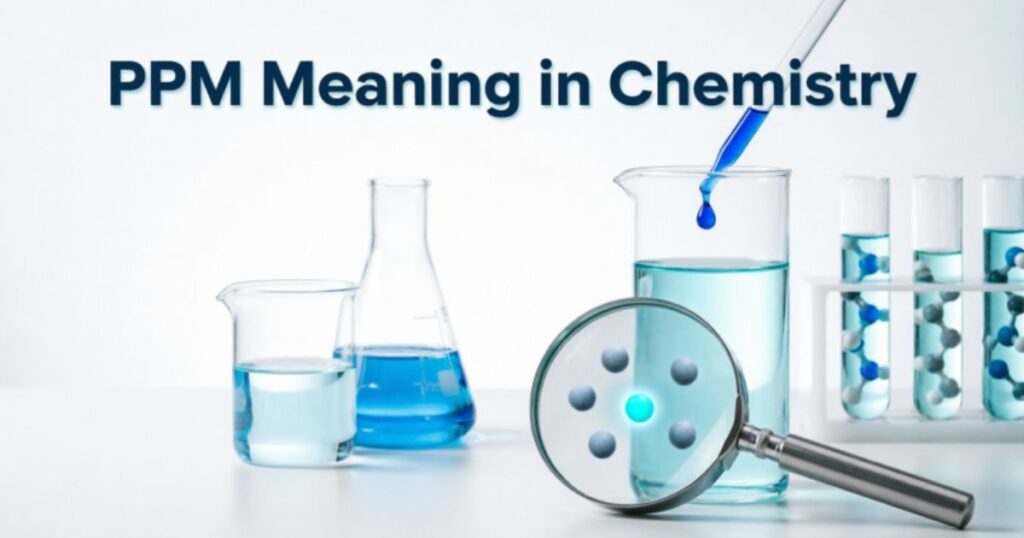
The ppm meaning in chemistry is parts per million. It shows how much of a substance (called the solute) is present in a mixture. It is a way to express PPM concentration when amounts are tiny.
Chemists use ppm because many important things exist in very small amounts. Think of trace metals in soil, minerals in drinking water, or gases in the air. Percent would give long strings of zeros. Ppm keeps numbers short and clear.
Also Read This: ONB Meaning in Text
There are two main ways to measure it:
- By mass: 1 ppm equals 1 milligram of substance per 1 kilogram of mixture (1 mg/kg).
- By volume: 1 ppm equals 1 milliliter of gas in 1,000 liters of air, or 1 part by volume in a million.
How to calculate ppm
The basic formula is:
ppm = (mass of solute / mass of solution) × 1,000,000
Here is an easy example. Say you dissolve 5 mg of a substance in 1 kg of solution. The math is 5 divided by 1,000,000, which equals 5 ppm.
Now some real PPM examples:
| Example | Typical Level |
| Free chlorine in a swimming pool | About 1 to 3 ppm |
| Fluoride in community water (US guidance) | About 0.7 ppm |
| Carbon dioxide in outdoor air | Above 420 ppm |
| Salt in seawater | About 35,000 ppm |
| Total dissolved solids, US EPA taste guideline | Under 500 ppm |
These numbers show why ppm is so flexible. It can describe a small chemical dose or a large one, as long as the whole is measured the same way.
Safety agencies also set limits in ppm. Air monitors for gases like carbon monoxide show readings in ppm, and alarms go off when the level gets too high. That is why this unit matters for health, not just for labs.
Variations / Types of PPM (Common Uses)
PPM has many faces. Here are the most common types and what each one stands for.
Parts per million. The measurement unit used in science, water testing, air quality, and food safety.
Defective parts per million. Used in manufacturing and quality control. A supplier with 20 PPM sends 20 faulty items for every million delivered. Car makers and electronics firms watch this number closely.
Project portfolio management. A business method for choosing and tracking projects across a company. Many software tools use this label.
Pre-production meeting. A key planning meeting in film, TV, and ad work.
Pages per minute. The speed rating of a printer or copier. A higher number means faster printing.
Planned preventative maintenance. A schedule of regular checks to stop equipment from failing. Common in building and facilities work.
Prepayment meter. A type of gas or electricity meter, common in the UK, where you pay before you use energy.
Portable Pixmap. A simple image file format with the .ppm extension. Programmers often use it for basic image tasks.
Private placement memorandum. A legal document used when a company raises money from private investors. Some finance readers will know this one.
The good news is that you rarely need to sort through all of these. Match the term to the field, and the answer appears.
How to Respond When Someone Uses “PPM”
Your reply depends on how sure you are about the meaning. Here is a simple approach.
Step 1: Check the context. Look at the topic, the sender, and the setting. A message from a lab points to parts per million. An invite from a producer points to a pre-production meeting.
Step 2: Ask if you are unsure. A polite question is always fine. It shows you care about getting things right.
Step 3: Reply clearly. Use the meaning you now understand, so the other person knows you are on the same page.
Here are some ready-made replies:
- “Quick check: do you mean parts per million or the project meeting?”
- “Thanks for the note. Can you spell out PPM for me?”
- “Got it. I will bring the water report to the PPM.”
- “Just to confirm, PPM here means pages per minute, right?”
If you are the one using the term, help your reader. Write it out in full the first time. For example, say “parts per million (ppm)” or “pre-production meeting (PPM).” After that, the short form is fine.
Regional & Cultural Usage of PPM
The core PPM meaning stays the same around the world, because science uses shared units. Still, local habits shape how people use the term.
In the United States, ppm is common in water testing, pool care, farming, and air quality. People often see it on home test kits and product labels.
In the United Kingdom, PPM also brings to mind the prepayment meter for gas and electricity. In building care, it can mean planned preventative maintenance. Both are everyday phrases there.
In India and other parts of South Asia, many households see ppm on water purifier displays. TDS readings in ppm are a common topic when people choose a filter. In factories, supplier quality is often reported in defective PPM.
In Europe, official reports often prefer mg/L or micrograms per cubic meter. Ppm still appears in science and industry, though. Some countries write it with a space, like “5 ppm,” while others may attach the number to the unit.
In film and media hubs such as Los Angeles, London, and Mumbai, PPM is a familiar crew word for the pre-production meeting.
Culturally, the unit has no special emotional weight. But attitudes to water, air, and safety do vary. In places where tap water is not always trusted, people may check ppm more often and talk about it more openly.
Conclusion: Understanding PPM Beyond the Definition
Knowing the PPM meaning is useful. Knowing how to apply it is better. The term is a small tool that helps people talk about tiny amounts, and it also stands in for a few workplace ideas.
When you meet PPM, pause and think about the setting. Is this about measurement, a meeting, or a machine? That one habit solves most confusion.
It also pays to understand scale. A number in ppm can sound big or small until you compare it with a limit or a normal range. Once you do, the number tells a real story about water, air, food, or quality.







One thought on “PPM Meaning: What It Really Stands For and Where It Counts”