

You are texting a friend. You share your day. Then they type back three letters: HBU. It looks small, but it carries a lot of meaning. It is one of the most common short forms used in casual chats, group texts, and social media replies.
This guide breaks down everything you need to know about HBU. You will learn what it means, when to use it, how to reply, and how it changes depending on who sends it. By the end, you will never wonder about this abbreviation again.
Quick Explanation
HBU stands for “How about you?” It is a short way to turn a question back to the person you are talking to. People use it after answering something about themselves, so the conversation keeps moving both ways.
Here is a simple example:
- Friend: I’m doing great, just finished work. HBU?
- You: Pretty good too, just relaxing at home.
That is the whole idea. One short question keeps the chat balanced instead of one-sided.
What Does HBU Mean in a Conversation?
In everyday texting, HBU means “how about you.” It usually comes right after someone shares an update, an opinion, or an answer. Instead of typing the full phrase, people shorten it to save time and keep the message casual.
You will often see it paired with a quick personal update first. For example: “I’m good, just tired from school. HBU?” The abbreviation signals that the sender wants to hear your side too, not just talk about themselves.
HBU works in almost any casual context. It fits in text messages, DMs, comments, and even voice-to-text conversations where people talk fast and skip full sentences.
Why Do People Say HBU?

People use HBU mainly because it is quick and easy. Typing three letters takes less effort than typing “how about you” every single time, especially during fast back-and-forth chats.
There are a few clear reasons this short form stays popular:
- It saves time while texting quickly.
- It keeps the conversation feeling balanced and polite.
- It shows interest in the other person’s answer.
- It fits naturally into a casual, friendly tone.
Using HBU also shows good texting manners. It tells the other person you care about their side of the story, not just your own update.
HBU After Different Questions
The meaning of HBU can shift slightly depending on what question came before it. It always means “how about you,” but the topic it applies to depends on context.
Here is a quick table to show how this works in practice:
| Original Question | Reply With HBU | What It Really Asks |
| How are you? | I’m good, HBU? | How are you feeling? |
| What are you doing? | Just watching TV, HBU? | What are you doing right now? |
| What are your plans tonight? | Staying in, HBU? | What are your plans tonight? |
| Did you eat yet? | Yeah just ate, HBU? | Have you eaten? |
As you can see, HBU borrows meaning from the question right before it. That is why context always matters more than the letters themselves.
HBU in Different Texting Situations
HBU shows up across many types of conversations, not just casual chats between friends. The tone changes based on where and with whom it is used.
In friendly chats, it usually follows small talk about the day, mood, or plans. In group chats, it can be aimed at everyone or just one specific person, so it sometimes gets a name tag before it, like “HBU Sarah?”
In slower, more thoughtful conversations, some people spell it out fully instead, especially when texting someone new or someone older. This keeps the message from feeling too rushed or too casual for the situation.
Hbu meaning in text from girl

When a girl sends HBU in a text, the meaning is still “how about you.” It does not automatically mean anything romantic or hidden by itself. Most of the time, it is simply polite conversation.
However, context around the message can add extra meaning. If she is asking about your day with genuine curiosity, replying quickly, and asking follow-up questions, it often shows real interest in keeping the chat going.
If the message is short, appears in a group setting, or comes with a long delay before replying, it is likely just casual conversation. The three letters alone do not signal flirting. The full pattern of the chat tells the real story.
Does HBU Sound Friendly or Flirty?
HBU by itself is neutral. It becomes friendly or flirty based on the tone, timing, and other words around it, not the abbreviation itself.
A few signs point toward a friendly, casual meaning:
- It appears in a normal daily check-in.
- Replies come and go without urgency.
- The topic stays simple, like work, school, or weekend plans.
A few signs point toward a flirtier tone:
- It follows a compliment or a personal question.
- Replies come fast, with emojis or playful teasing.
- The person asks follow-up questions that show curiosity about you specifically.
Reading the whole conversation always works better than judging one short word alone.
HBU vs HYD vs WBU
These three abbreviations often confuse people because they sound similar and get used in similar spots. Here is a clear side-by-side comparison.
| Abbreviation | Full Meaning | Common Use |
| HBU | How about you | Turning a question back after sharing an update |
| HYD | How you doing | Asking about someone’s current mood or state |
| WBU | What about you | Almost identical to HBU, used interchangeably |
HBU and WBU mean nearly the same thing and are often used the exact same way. HYD is slightly different because it asks directly about someone’s current state rather than reflecting a question back.
Most people pick whichever short form feels natural to their typing style. There is no strict rule about which one to use.
How to Reply to HBU
Replying to HBU is simple. You just answer the question that was asked earlier in the conversation, using yourself as the subject.
Here are a few natural reply examples:
- If asked “How are you? HBU?” reply with “I’m doing okay, just a busy day.”
- If asked “What are you up to? HBU?” reply with “Nothing much, just relaxing.”
- If asked “Any plans this weekend? HBU?” reply with “Thinking about a movie, maybe.”
A good reply usually matches the length and tone of the original message. Short, casual questions deserve short, casual answers. Longer, detailed messages usually deserve a bit more detail back.
Is HBU Formal or Informal?
HBU is informal. It belongs in casual texting, group chats, and social media, not in professional emails or formal writing.
In workplace messages, it is better to write out the full phrase, such as “How about you?” This keeps the tone professional while still asking the same question. Abbreviations like HBU can come across as too casual in serious settings, especially with clients or higher-ups.
Among friends, classmates, or in relaxed online spaces, HBU fits perfectly. It matches the quick, informal style most people already use while texting.
HBU in Social Media and DMs
On platforms like Instagram, Snapchat, TikTok, and Twitter, HBU appears constantly in direct messages and comments. It fits the fast pace of these platforms, where short replies are the norm.
People often use it after replying to a story, a post, or a comment. For example, someone might comment “Nice pic! HBU, how was your weekend?” under a photo. It keeps engagement going without requiring long typing.
In DMs specifically, HBU often works as a way to keep a conversation alive. When a chat starts to slow down, adding HBU gently invites the other person to share more and continue talking.
HBU meaning in business

In business or professional contexts, HBU is rarely used directly. Most professional communication avoids texting slang, since it can look unprofessional in emails or official messages.
That said, informal internal chats, like quick messages between coworkers on messaging apps, sometimes still use it. A coworker might type “Doing fine, just finishing a report. HBU?” in a casual internal chat tool.
Also Read This: CM Meaning in Text
For anything client-facing, formal emails, or official documents, it is safer to always spell out “How about you?” This keeps a polished, respectful tone that matches professional standards.
HBU in Dating and Flirty Conversations
In dating apps and early conversations with someone you like, HBU often shows up naturally. It usually appears after sharing something personal, like an interest, a plan, or a feeling.
For example: “I love hiking on weekends, HBU?” This kind of message invites the other person to share something about themselves too, helping both people get to know each other.
The word itself is not flirty, but its placement in a dating conversation often carries a warmer tone. Combined with compliments, quick replies, and genuine curiosity, HBU can feel like a small but real signal of interest.
Examples of HBU in Real Texts
Seeing HBU in real conversation examples makes its use much clearer. Here are a few natural, everyday scenarios.
Casual friend chat:
- “Just got home from school, so tired. HBU?”
- “Same here, homework is piling up.”
Group chat:
- “Anyone free tonight? HBU guys?”
- “I’m down, what time?”
Dating chat:
- “I’m really into photography lately. HBU, any hobbies?”
- “That’s cool, I’ve been getting into painting.”
Each example shows the same basic pattern. Share something, then ask HBU to hear the other side.
Common Mistakes With HBU
A few small mistakes happen often when people use or interpret HBU. Knowing them helps avoid confusion in conversations.
- Using HBU in formal emails or professional documents.
- Assuming HBU always means romantic interest, even in plain conversations.
- Forgetting to answer the original question before asking HBU back.
- Sending HBU with no earlier context, which can confuse the reader.
Avoiding these mistakes keeps conversations clear and appropriate for the setting they happen in.
Other Meanings of HBU
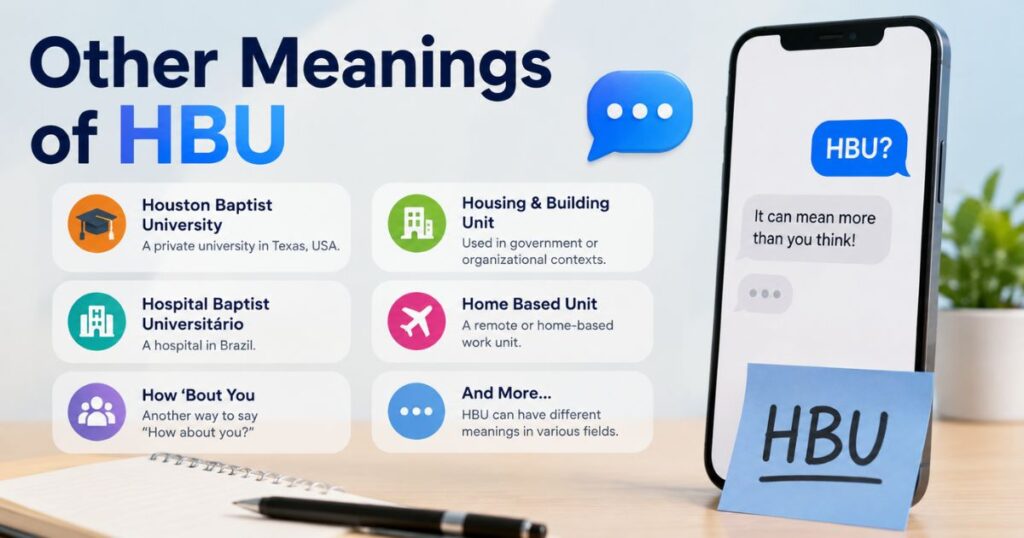
While “how about you” is by far the most common meaning, HBU can occasionally stand for other things depending on the context, such as usernames, brand names, or specific online communities.
In everyday texting between people, though, these alternate meanings are extremely rare. Almost every normal chat using HBU refers to “how about you.” If a message seems unrelated to a personal question, it may be tied to a specific niche or platform rather than standard texting slang.
Similar Texting Abbreviations
Many other short forms follow the same casual texting style as HBU. Knowing a few common ones helps with understanding modern text conversations overall.
| Abbreviation | Meaning |
| WYD | What are you doing |
| HMU | Hit me up |
| TTYL | Talk to you later |
| IDK | I don’t know |
| NVM | Never mind |
These abbreviations share the same goal as HBU: quick, casual communication that fits the fast pace of texting and messaging apps.
Final Thoughts
HBU is a simple, friendly way to keep conversations balanced. It shows the other person that you care about their answer too, not just sharing your own update and moving on. Whether it appears in a friend group chat, a work messenger, or a dating app, the core meaning stays the same: how about you.
Context always shapes how it feels. The same three letters can sound plain and casual in one chat, or warm and interested in another. Paying attention to tone, timing, and the full conversation gives a much clearer picture than the abbreviation alone ever could.



One thought on “HBU Meaning in Text: The Real Question Behind Every Reply?”