

You are scrolling through your messages and a friend writes, “istg I am never trusting that weather app again.” You know it is slang, but what does it really say? Is it serious? Is it a joke? Is it anger?
The short answer is simple. ISTG stands for “I swear to God.” People use it to stress a point, show strong feelings, or add drama to a story. This guide explains the meaning, the tone, and the right way to use it.
ISTG Meaning – Quick Explanation
ISTG means “I swear to God.” It is a texting abbreviation used to add emphasis. When someone types it, they want you to know they feel strongly about what they just said.
It can show many moods. Sometimes it is frustration, like “istg my phone is at 1% again.” Sometimes it is excitement, like “istg that concert was the best night of my life.” Sometimes it is a promise, like “istg I will call you tomorrow.”
Here is a quick view of the term:
| Detail | Answer |
| Full form | I swear to God |
| Type | Internet slang and texting abbreviation |
| Main purpose | Add emphasis or strong feeling |
| Common tone | Frustrated, dramatic, sincere, or funny |
| Where it appears | Texts, TikTok, Instagram, X, Snapchat, Discord |
| Formality level | Very casual |
Most of the time, ISTG is not about religion at all. It is just a way to make a sentence hit harder, much like “I mean it” or “seriously.”
Origin and Background of ISTG
ISTG grew out of the same habit that gave us OMG, LOL, and BRB. People wanted to type faster, so they cut long phrases down to letters. “I swear to God” is a phrase people have said out loud for a very long time. Typing it out every time felt slow, so the short form took over.
The abbreviation became common as text messaging, instant messaging, and social media grew. Short posts and quick chats rewarded short words. Younger users, especially teens and young adults, helped spread it across apps.
Later, platforms like Twitter, Tumblr, Instagram, and TikTok gave it a bigger stage. Captions, comments, and video text all have limited space, so ISTG fit well. It also worked for a dramatic voice, which is a big part of online humor.
The phrase behind it has old roots. Swearing an oath to God has long been a way to say “I am telling the truth.” Over time, everyday speech stretched the phrase. People began using it for small things, like a late bus or a spoiled movie. The abbreviation carried that habit into the digital world.
ISTG in Real-Life Conversations

ISTG shows up in chat far more often than in spoken talk. Still, some people say it out loud as letters, like “I-S-T-G,” mostly as a joke. Most of the time, they simply say the full phrase.
Here are common ways people use it in daily messages:
- To show frustration: “istg if this train is late again I am walking.”
- To make a promise: “I will pay you back on Friday.”
- To share excitement: “This song gets better every time.”
- To show disbelief: “istg she said that with a straight face.”
- To complain playfully: “istg my dog knows when I sit down to work.”
Tone matters a lot. Between close friends, ISTG feels light and playful. With a boss or a teacher, it can feel too casual. Many people would avoid it in work emails or formal notes.
Placement is flexible too. You can put it at the start of a sentence, the middle, or the end. “Istg I am tired” and “I am so tired istg” both work. Most people type it in lowercase, since caps can make it feel like shouting.
ISTG meaning from a girl
Many people search for what ISTG means when a girl sends it. The truth is that the word itself means the same thing no matter who types it. Still, the message around it can shape how you read the tone.
When a girl uses ISTG in a chat, it often adds emotion. It may show that she is annoyed, amused, or very serious. The rest of the message and the emojis usually tell you which one.
Here are a few examples:
| Message | Likely meaning |
| “istg you are so funny 😂” | She finds you very funny |
| “Istg if you forget my birthday…” | Playful warning, or real worry |
| “istg I am not mad” | She may be a little bit mad |
| “istg I miss you” | Sincere and affectionate |
| “istg you always do this” | Annoyed, but maybe teasing |
Do not read too much into one short word. ISTG is a style choice, not a secret code. If the tone feels unclear, ask her. A simple “Are you joking or upset?” clears things up fast.
It also helps to look at your past chats. If she often uses ISTG with jokes, it is probably just her texting voice. If she rarely uses it, the message may carry more weight.
The Emotional and Psychological Meaning of ISTG
Words like ISTG work because they carry emotion in very few letters. Text has no voice or face. A person cannot hear a sigh or see a smile. So we add small tools to show feeling, and ISTG is one of them.
At its core, ISTG is about being believed. When someone swears to something, they want you to trust them. Even in a joke, that instinct is there. “Istg I did not eat your fries” is funny because it acts like a courtroom oath.
It also works as a way to release stress. Small annoyances pile up in daily life. Typing “istg” gives a quick outlet, like a mild sigh you can share with a friend. It makes the complaint feel shared instead of lonely.
Also Read This: SMS Meaning Explained
There is a social side as well. Using the same slang as your friends creates a sense of belonging. Teens and young adults often use these shortcuts to sound close and relaxed with each other.
Finally, ISTG can show strong sincerity. When a friend writes “istg I am proud of you,” the word adds weight. It tells you the feeling is real and not just polite.
ISTG in Different Contexts
The meaning stays the same, but the mood shifts with the setting. Here is how ISTG behaves in the places you will see it most.
Text Messages
In private chats, ISTG is very common. It adds color to short replies and helps friends read each other’s mood. Tone comes from the message, the timing, and the emojis.
TikTok
On TikTok, ISTG appears in captions, comments, and on-screen text. Creators use it for dramatic storytime videos, relatable jokes, and reactions. A caption like “istg this took me 10 tries” makes the video feel honest and funny at once.
Instagram and Snapchat
On Instagram, you will see it in captions, stories, and comments. On Snapchat, it fits fast, casual chats. In both places, it keeps posts short and expressive.
X, Discord, and Gaming Chats
In fast public threads and gaming lobbies, ISTG can show irritation or hype. A player might write “istg that was the last second” after a close match. It keeps the message quick.
Work and School
In formal spaces, ISTG is usually a poor fit. Emails, reports, and class messages call for clear and polite language. Save it for friends and casual groups.
| Context | Typical tone | Good to use? |
| Text with friends | Playful or serious | Yes |
| TikTok captions | Dramatic or funny | Yes |
| Group chats | Casual | Yes |
| Work email | Formal | No |
| School message to a teacher | Respectful | No |
Common Misunderstandings About ISTG
Because the term includes a religious word, people sometimes get confused. Here are the most common mix-ups.
“ISTG is always an angry message.” This is not true. Yes, it often shows frustration. But it can also show joy, love, or laughter. Read the whole message before deciding.
“It is a real oath.” In almost every casual chat, it is not. Most people use it as a figure of speech, not a serious vow. Nobody expects a promise made in a meme caption to hold in court.
“It is disrespectful to religion.” Some people do feel uneasy about it, and that view deserves respect. If you are chatting with someone who dislikes it, you can skip it. Many others see it as ordinary slang with no religious meaning.
“ISTG and ISTJ are the same.” They are not. ISTJ is a personality type from the Myers-Briggs system. It has nothing to do with the slang term. Only one letter separates them, so people mix them up in searches.
“Only teens use it.” Teens and young adults use it the most, but adults use it too. It has spread across many age groups, especially in casual online talk.
A good rule is simple. Look at the tone, the sender, and the setting before you decide what ISTG means in that moment.
Istg meaning in personality
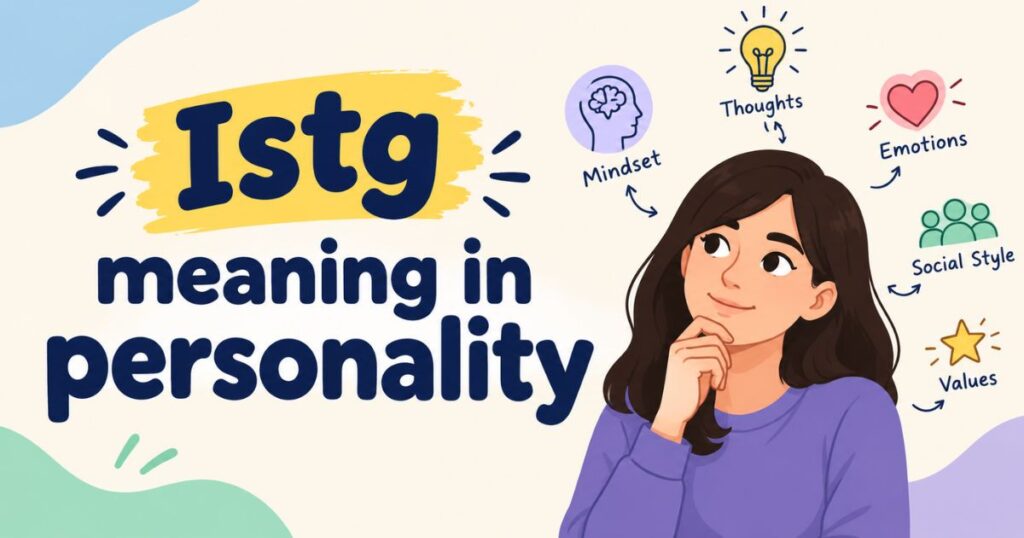
A lot of people search for “its meaning in personality.” Most of the time, they are thinking of a different term, ISTJ, which is one of the 16 Myers-Briggs personality types. ISTG the slang and ISTJ the personality type are two separate things.
ISTJ stands for Introverted, Sensing, Thinking, and Judging. People with this type are often described as practical, careful, and reliable. They like order and clear rules.
The slang ISTG, on the other hand, has no official link to any personality type. However, you can still say something about the people who use it often. Someone who types ISTG a lot tends to be expressive and dramatic in a fun way. They may like to add feelings to daily stories.
| Term | What it is | Meaning |
| ISTG | Internet slang | I swear to God |
| ISTJ | Personality type | Introverted, Sensing, Thinking, Judging |
If you mean the personality type, you are looking for ISTJ. If you meant the text slang, you are in the right place. Heavy ISTG use does not tell you a person’s type. It only shows their texting style.
ISTG vs. Similar Slang and Expressions
ISTG has a lot of cousins in online language. They share a similar job, which is to add emphasis, but each one has its own flavor.
| Slang | Meaning | How it differs from ISTG |
| ISTG | I swear to God | Strong emphasis, often dramatic |
| OMG | Oh my God | A reaction to something surprising |
| FR | For real | Agreement or honesty, calmer tone |
| NGL | Not gonna lie | Introduces an honest opinion |
| IDK | I don’t know | Shows uncertainty |
| IKR | I know, right | Shows agreement |
| SMH | Shaking my head | Shows disappointment |
| ONG | On God | Very similar to ISTG, used to swear something is true |
| FRFR | For real, for real | Extra strong version of FR |
The closest match is ONG, which also means you are swearing something is true. ISTG tends to sound a bit more dramatic and is often used in complaints. OMG is a reaction, while ISTG is a statement of intensity.
FR and NGL feel gentler. They ask for trust without the oath. ISTG has more punch, so it fits big feelings and big claims.
Variations and Types of ISTG Usage
People play with ISTG in many ways. Here are the most common styles.
- Lowercase “istg”: The everyday form. It feels relaxed and casual.
- Uppercase “ISTG”: Louder and more intense. Good for big reactions.
- “ISTG” alone: Sometimes used as a full reply to show frustration without more words.
- “Istg” at the end: Adds emphasis after the point, like “I am done istg.”
- “Istg” with emojis: Emojis shape the mood. A laughing face makes it funny, while an angry face makes it sharp.
- Stretched versions: Some people write “istgggg” to show extra feeling.
You can also group usage by purpose:
| Type | Purpose | Example |
| Emphatic | Stress a point | “istg this is the best pizza” |
| Promise | Show commitment | “istg I will be on time” |
| Complaint | Vent annoyance | “istg my neighbor’s music” |
| Joking | Add comic drama | “istg I did not touch it” |
| Warning | Playful threat | “istg if you spoil the show” |
| Sincere | Show real care | “istg I am so glad you came” |
The variation you pick sets the tone. If you want to sound light, use lowercase and add a fun emoji. If you want to sound serious, keep it short and skip the emojis.
Regional and Cultural Usage

ISTG is most common in American English, since it grew alongside US social media culture. It is also popular in Canada, the UK, Australia, and other English-speaking countries, where young people share the same apps and trends.
In many non-English regions, people use ISTG inside English-mixed chats. For example, a message in another language may still include “istg” for emphasis. Global platforms like TikTok and Instagram make this easy, since trends travel fast.
Culture and faith shape how comfortable people feel with it. In communities where swearing to God is taken seriously, some people avoid the phrase and its short form. Others use it casually and see no harm. Neither view is wrong.
Different regions also have their own local versions. In some places, people prefer phrases like “I promise,” “no cap,” or “on my life.” Each carries a similar sense of honesty. What stays the same is the human wish to be believed.
If you are chatting across cultures, it is wise to notice how the other person writes. If they avoid religious terms, you can do the same. A little awareness keeps the chat friendly and respectful.
Final Thoughts
ISTG means “I swear to God,” and it works as a fast way to add emphasis in text. People use it to stress a point, share strong feelings, or make a playful promise. It began as a shortcut for a phrase people already said out loud, and social media helped it spread.
The tone can change from one message to the next, so always read the full context. It is casual, expressive, and best kept for friends and relaxed online spaces. Keep it away from formal writing, and be kind to anyone who prefers not to use it.





One thought on “ISTG Meaning: What It Really Means in Texts and on TikTok!”