
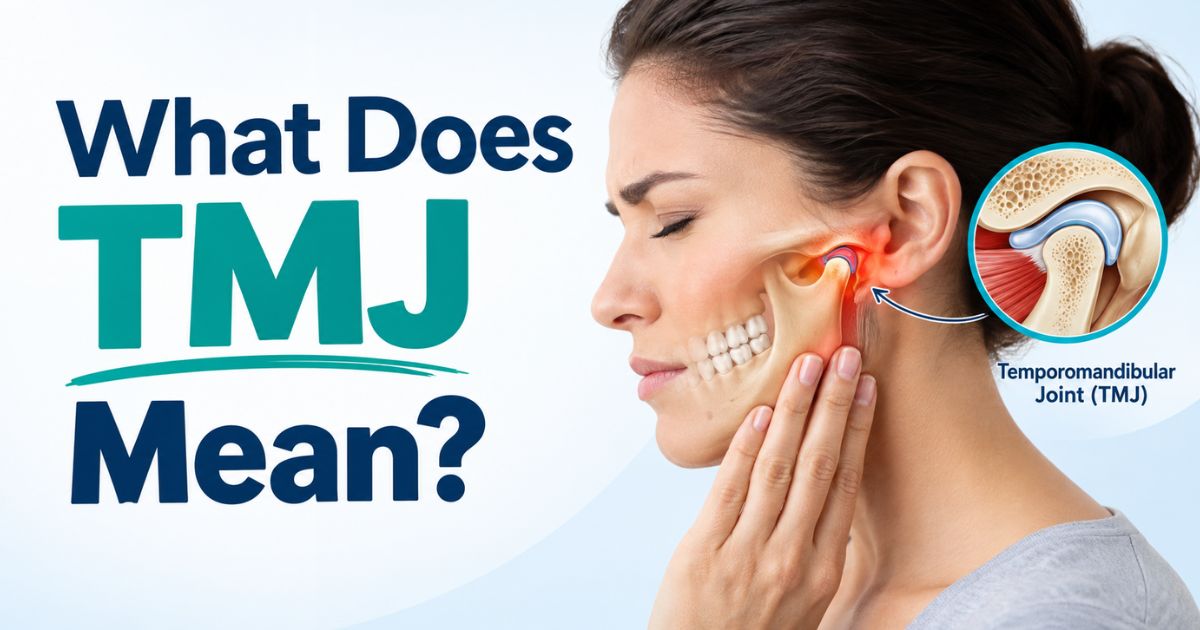

You may have seen “TMJ” in a doctor’s note, a dental office, or a text message. It looks simple, but people often wonder what it really stands for. The answer depends on where you see it.
This guide explains what TMJ means in plain words. You will learn where the term comes from, how people use it in daily talk, and what to do if you or someone you know has jaw trouble.
TMJ – Quick Meaning
TMJ stands for temporomandibular joint. It is the joint that connects your lower jaw to the side of your skull. You have two of them, one on each side of your face, just in front of your ears.
These joints work every time you talk, chew, yawn, or swallow. They let your jaw move up, down, and side to side. Without them, even a simple sandwich would be hard to eat.
In everyday speech, many people also use “TMJ” to describe jaw pain or jaw problems. Strictly speaking, that is not correct. The joint is TMJ. The problems that affect it are usually called TMD, short for temporomandibular disorders.
Here is a quick snapshot:
| Item | Detail |
| Full form | Temporomandibular joint |
| Where it is | Where the jaw meets the skull, near each ear |
| Main job | Helps you chew, talk, and open your mouth |
| Number in the body | Two, one on each side |
| Common casual use | A short way to say jaw joint pain or jaw trouble |
So if someone asks, “What does TMJ mean?” the short answer is this: it is the jaw joint, and people often use the word when they talk about pain in that joint.
Origin & Background
The word “temporomandibular” is a mix of two body parts. “Temporal” comes from the temporal bone, which is part of the skull. “Mandibular” comes from the mandible, which is the lower jaw bone. Put together, the name simply points to the place where those two bones meet.
Doctors have studied jaw problems for a long time. In 1934, an ear, nose, and throat doctor named James Costen described a group of symptoms that included jaw pain, ear discomfort, and headaches. For years, this pattern was known as Costen’s syndrome. It helped bring public attention to the jaw joint.
Later, the phrase “TMJ syndrome” became popular. It was easy to say, so it spread fast in clinics and in daily life. Over time, experts noticed that jaw problems are not one single condition. They can come from the muscles, the joint, or both.
Because of that, many health professionals now prefer the term TMD. It covers the wide range of issues that can affect the joint and the muscles around it. Still, “TMJ” stuck in everyday language, and most people use it freely.
Real-Life Conversations (Mandatory)
Real talk shows how a term works better than any definition. Here are several everyday situations.
Conversation 1: At the Dentist
Patient: My jaw clicks every time I open my mouth wide. Is that bad?
Dentist: It might be related to your TMJ. That is short for temporomandibular joint. It is the joint that lets your jaw move.
Patient: So TMJ is a body part?
Dentist: Yes. A click alone is often harmless. If it comes with pain or locking, we should look closer.
Conversation 2: Two Friends Chatting
Maya: I skipped the steak. My jaw has been sore all week.
Jordan: Did you get it checked?
Maya: My dentist said it could be TMJ trouble. Basically, the joint in my jaw is irritated.
Jordan: Oh, so TMJ is the joint, and the pain is the problem?
Maya: Exactly. Technically the problem is called TMD, but everyone just says TMJ.
Conversation 3: A Text Message Mix-Up
Sam: Ugh, my TMJ is acting up again.
Chris: Wait, what does TMJ mean in a text? Is that slang?
Sam: Ha, no. It is my jaw joint. I have been clenching my teeth from stress.
Chris: Got it. I thought it was some new internet abbreviation.
Conversation 4: At the Office
Coworker: You keep rubbing your face. Are you okay?
Priya: My jaw hurts. I think it is my TMJ from grinding my teeth at night.
Coworker: What is TMJ exactly?
Priya: It stands for temporomandibular joint. It is the hinge that connects the jaw to the skull.
Conversation 5: A Parent and a Teen
Teen: My dentist said I might need a night guard because of my TMJ.
Parent: What does that mean?
Teen: TMJ is the joint in my jaw. I grind my teeth in my sleep, and the guard protects them and eases the pressure.
Parent: That makes sense. Let us book a follow-up visit.
What does tmj mean in text
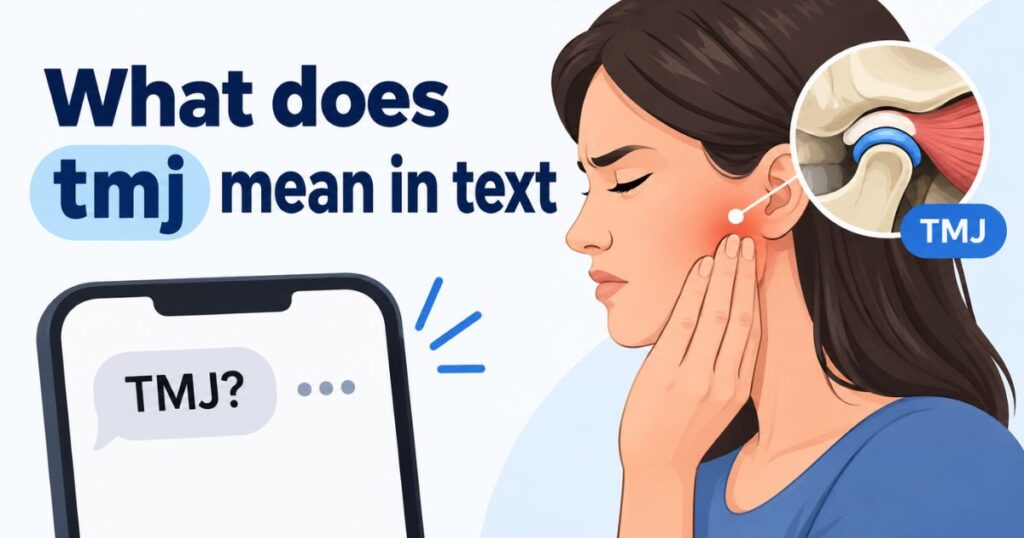
In a text or chat, TMJ most often means the same thing it means in real life. It refers to the temporomandibular joint or to jaw pain. If a friend writes, “My TMJ is killing me today,” they are talking about their jaw.
Context is the key. Look at the words around it. If the message mentions chewing, clenching, headaches, or a dentist, it is almost surely about the jaw. That is the standard meaning, and it is the one you can trust most.
Some people may use TMJ as a playful acronym in private jokes or in certain online groups. Those meanings are not standard. They are not widely recognized, and they can change from group to group. Nobody can say they are universal.
If you are not sure, just ask. A quick reply like “Do you mean your jaw?” clears things up in seconds. It is better to check than to guess wrong.
Here is a simple way to read it:
- Health or body talk nearby: it means the jaw joint.
- Mentions of stress, grinding, or clenching: it points to jaw tension.
- No clear context at all: ask the person what they mean.
Emotional & Psychological Meaning
TMJ is a physical joint, but it is closely tied to emotions. The jaw is one of the places where people hold stress. Many people clench or grind their teeth when they feel anxious, angry, or under pressure. They often do it without noticing.
Because of this link, people sometimes use “my TMJ” as a way to say they are stressed. A person who says, “My TMJ is flaring up,” may be telling you that life has been heavy lately. It can be a quiet signal.
Living with jaw pain can also affect mood. Constant soreness makes it hard to enjoy meals. It can disturb sleep and make talking tiring. Over time, this can leave a person feeling frustrated, worn out, or even isolated.
It helps to be kind and patient with someone who has jaw trouble. Stress does not cause every case, and it is not a sign of weakness. But learning to relax the face and jaw can make a real difference for many people.
Small habits that may help with tension include:
- Slow, deep breathing during stressful moments
- Noticing when your teeth are touching and letting your jaw rest
- Taking short breaks from screens and desks
- Talking to a professional if stress feels too big to manage alone
Usage in Different Contexts
The word TMJ shows up in many places. The meaning stays close to the jaw joint, but the way people use it can change a bit.
| Context | How TMJ is used | Example |
| Medical | Names the joint itself | “The scan shows the left TMJ is inflamed.” |
| Dental | Talks about jaw problems and bite issues | “We should check your TMJ before making a night guard.” |
| Casual talk | A short way to say jaw pain | “My TMJ is bothering me today.” |
| Text and social media | Mentions jaw trouble or shares health tips | “Does anyone else deal with TMJ flare-ups?” |
| Fitness and wellness | Talks about jaw tension and relaxation | “Jaw stretches helped my TMJ.” |
In medical settings, doctors use the term precisely. They may say “the TMJ” when they mean the joint and “TMD” when they mean the disorder. Charts and reports follow this pattern.
In daily life, the line is much softer. People say “I have TMJ” when they really mean “I have a jaw disorder.” Most listeners understand, so it rarely causes a problem.
On social media, TMJ often appears in health posts, support groups, and self-care tips. In those spaces, it nearly always means jaw pain. If you see it there, you can safely assume that is the topic.
Common Misunderstandings
A few mix-ups come up again and again. Clearing them up makes the topic much easier to follow.
Misunderstanding 1: TMJ is a disease. It is not. TMJ is a normal joint that everyone has. What can go wrong are the problems that affect it, which are called TMD.
Misunderstanding 2: Every jaw click means something is wrong. Many people have clicking or popping sounds and feel no pain at all. If there is no pain and the jaw moves freely, it often needs no treatment. It is still wise to mention it to a dentist.
Also Read This: ISTG Meaning
Misunderstanding 3: TMJ pain is only in the jaw. It can spread. Some people feel it in the face, neck, or shoulders. Others notice earaches, headaches, or a feeling of pressure near the ears.
Misunderstanding 4: It always needs surgery. This is rarely true. Most people improve with simple care, such as rest for the jaw, soft foods, and stress control.
Misunderstanding 5: TMJ means the same thing everywhere. In health talk, it means the jaw joint. In casual chat, a few people might use it in other ways, but those are not standard. Always check the context.
TMJ treatment

Treatment depends on the cause and how strong the symptoms are. Many cases ease with simple steps at home. Others need help from a dentist or doctor.
Common self-care steps include:
- Eating soft foods for a while
- Avoiding gum and very chewy snacks
- Using a warm or cold pack on the sore area
- Doing gentle jaw stretches, if a professional approves
- Cutting back on wide yawning and jaw-heavy habits
If self-care is not enough, a dentist or doctor may suggest other options. A custom night guard or splint can protect the teeth and lower pressure on the joint. Physical therapy can help loosen tight muscles. Some people take over-the-counter pain relievers for short periods, as advised by a health professional.
In tougher cases, doctors may try injections or other procedures. Surgery is uncommon and is usually a last choice after other methods have not worked.
Please note that this article is for general information only. It is not medical advice. If you have ongoing jaw pain, trouble opening your mouth, or a jaw that locks, please see a dentist or doctor. They can find the cause and suggest a plan that fits you.
Comparison Table
TMJ is often mixed up with related terms. This table shows the differences side by side.
| Term | Full form | What it means | Is it a condition? |
| TMJ | Temporomandibular joint | The jaw joint itself | No, it is a body part |
| TMD | Temporomandibular disorders | Problems with the jaw joint or nearby muscles | Yes |
| Bruxism | Not an acronym | Grinding or clenching the teeth | Yes, a habit or condition |
| Jaw clicking | Not applicable | A sound the jaw makes when moving | Not always, often harmless |
Here is another quick comparison of the two terms people confuse most.
| Feature | TMJ | TMD |
| Type | Joint | Disorder |
| Everyone has it | Yes | No |
| Used by doctors for | Naming the joint | Naming the problem |
| Used by the public for | Both the joint and the pain | Less often used |
Knowing this difference helps you talk clearly with a health professional. It also helps you search for the right information online.
How to Respond When Someone Uses It
The right reply depends on where and how the word was used. A little care goes a long way.
If someone uses TMJ to describe pain, respond with kindness. You can say, “That sounds painful. Is there anything I can do to help?” Simple support means more than advice they did not ask for.
If you are not sure what they mean, ask in a friendly way. Try, “Do you mean your jaw joint?” This avoids confusion and shows that you care about getting it right.
If someone shares that they have TMJ trouble, avoid dismissing it. Comments like “It is just a sore jaw” can feel unfair. Jaw pain can be very draining.
Here are a few easy replies you can use:
- In person: “I am sorry to hear that. Have you talked to a dentist?”
- In a text: “Oh no, is your jaw acting up again? Take it easy today.”
- When you are confused: “Sorry, what does TMJ mean here? Is it your jaw?”
- When you want to help: “Want me to pick up some soft food for you?”
If the person seems stressed, gentle support can help. A quiet check-in is often enough.
Final Thoughts
TMJ is a simple term with a clear main meaning. It is the joint that lets your jaw move, and it plays a part in eating, speaking, and even showing emotion. People often use it for jaw pain too, so it helps to know the difference between the joint and the disorders that can affect it.
If you meet the word in a message, check the context and ask when you are unsure. If jaw discomfort keeps coming back, a dentist or doctor can guide you to the right care. A little awareness now can save a lot of discomfort later.




2 thoughts on “What Does TMJ Mean? Jaw Joint Meaning, Texts and Real Talk”