
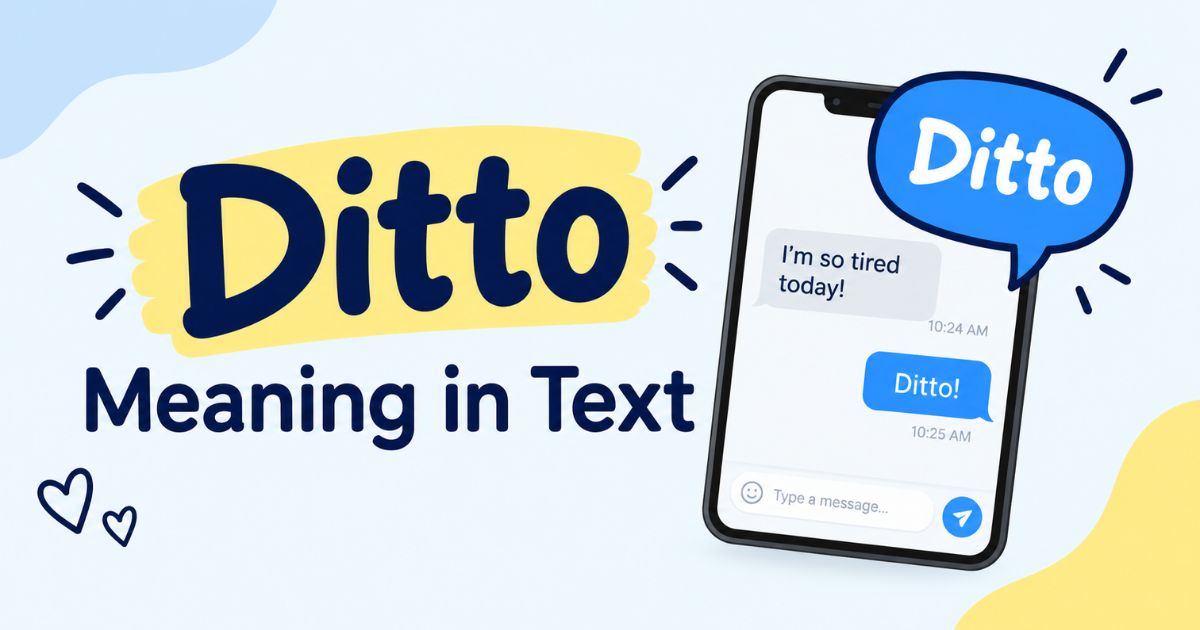

You have probably seen someone reply to a message with just one word: “ditto.” It looks simple, but many people still wonder what it really means. Is it sweet, lazy, funny, or just a quick way to say yes? The answer depends on who sends it and how.
This guide explains the ditto meaning in text in plain and simple words. You will learn where the word came from and how people use it with friends, family, and partners. You will also see funny examples, common mix-ups, and easy ways to reply.
Ditto Meaning in Text Quick Definition
Ditto in text means “same here” or “I feel the same way.” It is a short reply people use to agree with something without repeating it. If someone texts “I miss you” and you reply “Ditto,” you are saying “I miss you too.”
The word works as a shortcut. It saves time and keeps the chat light. You will often see it in replies to compliments, greetings, and kind messages.
Here is the simplest way to remember it:
- Ditto = me too
- Ditto = same to you
- Ditto = I agree
That is the core meaning. The tone can change depending on who sends it and how, but the idea stays the same.
Origin & Background
The word “ditto” comes from Italian. It is linked to the Italian word “detto,” which means “said.” Long ago, merchants and bookkeepers used it in written records. It told the reader that an item was the same as the one listed above it. That saved space and effort on paper.
Over time, the word moved into everyday English. By the 1700s and 1800s, people used it in writing and speech to mean “the same thing again.” Old lists, receipts, and office documents often used a mark that looked like two small quotation marks. Those marks stood for “ditto.”
In the 1990s, the word got a big pop culture boost. The movie Ghost made the reply famous in a romantic scene. After that, many people linked “ditto” with love and emotional connection. That romantic feel still lingers today.
Then texting arrived. Short replies became normal, and “ditto” fit perfectly. It is quick to type, easy to understand, and works in almost any casual chat.
Real-Life Conversations (How People Actually Use “Ditto”)
Most people use ditto as a fast reply. They do not want to type a long message when a single word does the job. Here are some realistic examples.
Example 1: Sweet message
Her: Can’t wait to see you tonight. Him: Ditto.
Example 2: Friendly wish
Friend: Have a great weekend! You: Ditto! Enjoy the trip.
Example 3: Shared complaint
Coworker: I really need coffee right now. You: Ditto. This morning has been long.
Example 4: Family check-in
Mom: Love you, sweetheart. You: Ditto, Mom.
In each case, the reply repeats the feeling without repeating the words. That is why it feels smooth and natural. People also use it in group chats to show they agree with what someone else just said.
Many people type it in lowercase, like “ditto,” to sound relaxed. Others add an exclamation mark to sound warm or excited. Small changes like these shape how the message feels.
Emotional & Psychological Meaning
On the surface, ditto is only a short reply. Underneath, it often carries emotion. It tells the other person, “I hear you, and I feel it too.” That can create a quick sense of closeness.
In close relationships, ditto can feel warm and familiar. Couples often use it as a private shortcut for love. A partner might not write “I love you too” every time, but “ditto” still shows care. It becomes a small habit that both people understand.
Psychologists often talk about validation. People like to feel that their thoughts and feelings matter. When you say ditto, you confirm the other person’s feeling. That small confirmation can make the conversation feel safe and friendly.
However, tone matters a lot. A warm ditto builds connection. A flat, one-word ditto can feel distant, especially when the other person shares something deep. If someone opens up about their feelings, a longer reply usually feels more caring.
Here is a quick guide to how ditto can feel:
| Situation | How ditto may feel |
| Reply to “I love you” | Warm, but short |
| Reply to a joke | Playful and light |
| Reply to a serious confession | Possibly cold or lazy |
| Reply to a group opinion | Supportive and agreeable |
The best rule is to match the mood of the message. If the message is casual, ditto is fine. If the message is emotional, add a few more words.
Ditto meaning in text funny
Ditto is not always serious. People use it to joke, tease, and play around. Its short and dramatic style makes it perfect for humor.
One common joke is the fake serious ditto. Someone sends a long, dramatic message, and the friend replies with a single “ditto.” The contrast is what makes it funny.
Friend: I have made a life-changing decision. I am never waking up before 10 again. You: Ditto.
Another playful use is the stacked ditto. People type it several times to add energy, like “ditto ditto ditto.” This can show excitement or strong agreement. It can also feel silly and cute.
Sometimes ditto is used to copy someone’s joke. If one person sends a funny line, the other might reply “ditto” to say, “I was about to say the same.” It adds a light, fun rhythm to the chat.
People also use it in memes and captions. A photo of a messy desk might carry a caption like “Ditto, every Monday.” The word acts as a quick shared joke.
Funny uses work best with friends who understand your humor. With people you do not know well, a simple, clear reply is safer.
Usage in Different Contexts
Ditto changes slightly depending on where and how it is used. The meaning stays the same, but the tone shifts.
Casual chats with friends
This is the most common place to see it. Friends use ditto to agree, joke, or return a kind message. It feels relaxed and normal.
Social media
On platforms like Instagram, TikTok, and X, people drop ditto in comments and replies. It works as a quick “same here” under a post. It also shows up in captions and short videos.
Romantic texting
Here, ditto usually means “I feel the same.” It often replaces “I love you too” or “I miss you too.” Some people find it sweet. Others may want more words, so it depends on the couple.
Family messages
Parents, siblings, and cousins use ditto in easy, warm ways. A quick “ditto” after a family message feels friendly and simple.
Work and professional chats
In workplace chats like Slack or Teams, ditto is sometimes used among coworkers. For example, “Thanks for the update.” followed by “Ditto.” It is fine in casual team chats. In emails to clients or managers, it is better to write full sentences.
Online gaming and forums
Gamers and forum users often use ditto to agree with a comment or strategy. It keeps the thread short and easy to follow.
Here is a quick summary:
| Context | Typical meaning | Is it a good fit? |
| Friends | Same here | Yes |
| Social media | I agree | Yes |
| Romantic | I feel that too | Yes, with care |
| Family | Warm reply | Yes |
| Casual work chat | Agree or return thanks | Sometimes |
| Formal email | Not ideal | No |
Common Misunderstandings
Because ditto is so short, people sometimes read it the wrong way. Here are the most common mix-ups.
“Ditto means I don’t care.”
Not always. Many people use ditto because it is quick, not because they are uninterested. Still, if the message before it was emotional, the short reply can feel cold. Context is everything.
“Ditto is only romantic.”
This is a popular belief, mostly because of movies. In reality, ditto is used everywhere, from friend chats to work threads. Romance is only one part of its use.
Also Read This: TMI Meaning
“Ditto is the same as copying someone.”
In text, ditto is not about copying. It is about agreeing or returning a feeling. Nobody is being copied.
“Ditto is outdated.”
Some think ditto is an old word that nobody uses now. That is not true. It is still common in texting, and it keeps showing up in memes and social posts.
“Ditto always needs a follow-up.”
Usually it does not. A ditto can end a chat on a warm note. Extra words are optional, unless the topic is serious.
Another small mix-up happens with the Pokémon named Ditto. If someone talks about Pokémon, they may mean the character, not the reply. The topic of the chat usually makes this clear.
Comparison Table
Ditto is not the only way to agree in text. Here is how it compares with similar expressions.
| Expression | Meaning | Tone | Best used for |
| Ditto | Same here | Short, warm, casual | Quick agreement or returned feelings |
| Same | I feel the same | Very casual | Quick reactions to relatable posts |
| Me too | I share that feeling or experience | Friendly, clear | Almost any chat |
| Likewise | The same to you | Polite, a bit formal | Greetings and thanks |
| Right back at you | I send it back to you | Playful, warm | Compliments and wishes |
| Agreed | I agree with you | Neutral, clear | Opinions and decisions |
| Same here | I feel the same way | Friendly | Everyday chats |
| Ditto that | I agree with that | Casual, slightly emphatic | Group chats |
The main difference is feel. “Likewise” sounds more polite. “Same” sounds more casual. “Ditto” sits in the middle, with a friendly and slightly playful touch.
Ditto meaning in text urban dictionary
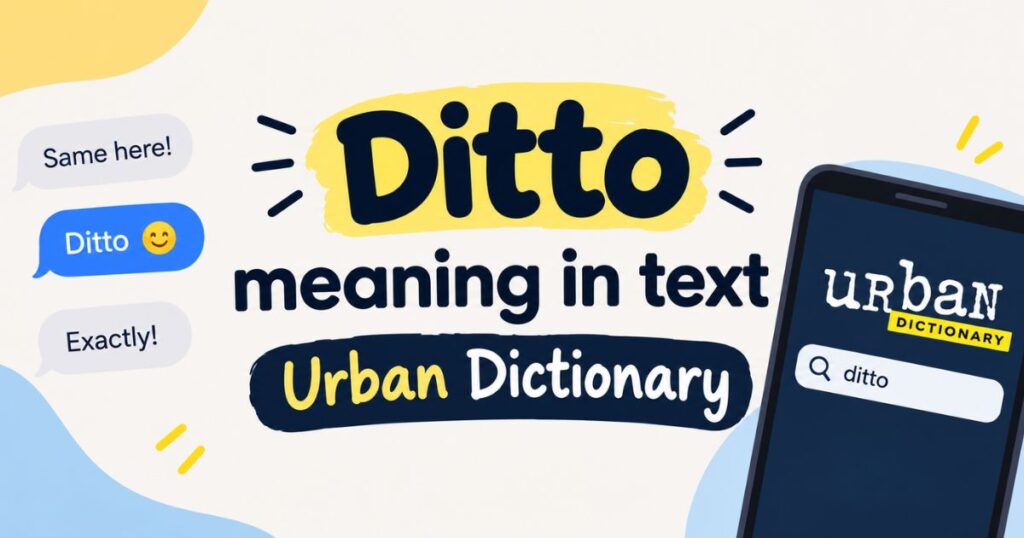
Many people search for the meaning of ditto on Urban Dictionary, a site where users add slang definitions. The entries there are written by regular people, so they can be casual, funny, or opinionated.
Most Urban Dictionary entries define ditto as “the same” or “me too.” Many describe it as a lazy but sweet way to say “I feel the same.” Some entries also mention the romantic link from the movie Ghost.
Other entries take a joking tone. Some describe ditto as a word people use when they do not know what else to say. Others call it a quick way to agree without adding anything new.
It is worth remembering that Urban Dictionary is not an official source. The definitions are user submitted, so some are exaggerated or humorous. Still, the main idea is consistent across most entries. Ditto means “same here.”
If you want a reliable meaning, trusted dictionaries agree with this basic definition. Urban Dictionary simply adds the social and playful side.
Variations / Types of “Ditto” (Modern Usage)
Like most slang, ditto has grown new forms. People change it to fit their mood and style. Here are some common variations.
- Ditto! The exclamation mark adds warmth or excitement.
- ditto All lowercase gives a calm, casual feel.
- DITTO All caps shows strong agreement or big energy.
- Dittooo Stretched letters add a cute or playful touch.
- Ditto ditto Repeating it shows enthusiasm.
- Ditto that A slightly longer form that clearly points to the last message.
- Ditto to that Similar, often used in group chats.
- Ditto, same A mix of two agreement words for extra emphasis.
- Ditto 💛 Adding an emoji makes it softer and more personal.
- Ditto 😂 A laughing emoji shows humor.
Emojis matter a lot here. A heart makes ditto feel loving. A laughing face makes it feel like a joke. No emoji at all can make it feel neutral or even a bit flat.
People also use ditto as a verb in casual speech. Someone might say, “I’ll ditto that,” meaning “I agree with that.” This is less common in texts but still appears in online comments.
How to Respond When Someone Says “Ditto”
Sometimes you send a message and get a “ditto” back. What should you say next? The answer depends on the topic and the person.
If the chat is light and casual
You can simply move on to the next topic or send a friendly emoji. No extra reply is needed.
You: Thanks for helping me today. Friend: Ditto. You: Anytime. 😊
If it is a romantic chat
A warm reply keeps the mood sweet. You can smile back with words or ask a follow-up.
You: I miss you. Partner: Ditto. You: Then let’s plan something for this weekend.
If you want more than one word
It is fine to ask for a little more. Do it kindly.
You: I really care about you. Partner: Ditto. You: That makes me happy. What do you like most about us?
If it is a joke
Play along. Reply with another funny line or a laughing emoji.
If it feels too short
Do not jump to conclusions. Many people use ditto out of habit. If it bothers you, mention it gently and explain how you feel.
The main tip is to read the tone. Ditto is usually friendly, so a relaxed reply is almost always fine.
Regional & Cultural Usage
Ditto is understood across most English-speaking countries. In the United States, it is very common in texting and everyday talk, especially after the popularity of Ghost in the 1990s. In the United Kingdom, Canada, and Australia, people also know it, though they may lean on phrases like “same here” or “likewise” more often.
Age can shape how people use it. Older adults may use ditto in a more traditional way, often in speech and short notes. Teens and young adults use it in quick chats, memes, and social media comments. They may also stretch it or add emojis to give it more personality.
Culture affects the feel too. In some cultures, short replies can seem too casual for close relationships. People may prefer longer and warmer messages. In others, a quick ditto is seen as friendly and efficient.
Language learners often pick up ditto from movies and social media. It is easy to learn because it is short and its meaning is clear. Still, learners should remember that it fits informal settings best.
Here are a few quick points:
- Ditto is widely understood in English-speaking regions.
- Younger people tend to use playful versions.
- Older people often use it more plainly.
- Formal situations call for full sentences.
Conclusion
Ditto is a small word with a clear job. In text, it means “same here” or “me too.” It works in friendly chats, romantic messages, family threads, social media, and casual work conversations.
Its history goes back to old Italian record keeping, and it grew popular through movies and everyday speech. Today, it lives on in texts, memes, and captions. The meaning stays simple, but the feeling behind it can change with tone, emojis, and timing.
The best way to use ditto is to match the mood. Use it for light, quick agreement. Add more words when the moment is serious or emotional.



2 thoughts on “Ditto Meaning in Text: What It Really Says When You Get It”