

You have probably seen “TMI” in a text, a comment, or a group chat. Maybe a friend shared a little too much about their breakfast, their date, or their doctor visit. Then someone replied with those three letters.
This guide explains the TMI meaning in plain words. You will learn where it came from, how people use it, and when it is smart to say it. You will also see what to avoid so you never sound rude by accident.
TMI Meaning – Quick Definition
TMI stands for “too much information.” People use it when someone shares details that are personal, awkward, gross, or simply unnecessary.
It works as a quick way to say, “I did not need to know that.” Most of the time, it is playful. It is rarely meant to hurt anyone.
Here is a simple way to think about it:
- Full form: Too Much Information
- Type: Slang abbreviation
- Tone: Usually light, joking, or mildly embarrassed
- Where it appears: Texts, social media, voice chats, and everyday talk
- Basic idea: The speaker shared more than the listener wanted
You can say it out loud as “T-M-I,” letter by letter. You can also type it in lowercase or capitals. Both are fine.
Origin and Background of TMI

The full phrase “too much information” is older than the abbreviation. People have said it for many years to react to oversharing. The short form “TMI” became common in the 1990s and grew fast in the 2000s.
Texting and the early internet helped a lot. Text messages had character limits, and chat rooms rewarded speed. Short forms like LOL, BRB, and OMG spread quickly, and TMI joined them.
Social media pushed it even further. When people began posting daily thoughts, meals, health updates, and relationship drama, oversharing became easy. TMI turned into the go-to reaction.
Today, the term is part of normal English. You can hear it on TV shows, in podcasts, and at the office. It is also used by people who never text in short forms.
Real-Life Conversations
The best way to understand TMI is to see it in action. Here are a few common situations.
Between friends:
“I ate three tacos and now my stomach is making noises.” “TMI, but okay, I hope you feel better.”
At work:
“I was up all night with a cold. I will spare you the details.” “Thanks, I appreciate that. Some things are TMI for the break room.”
In a family chat:
“Guess who got a new hairstyle and also a new dentist story?” “Save the dentist story. That sounds like TMI.”
On social media:
Someone posts a long, detailed account of a personal problem. A commenter replies, “Feeling TMI on this one, but sending good vibes.”
Notice the pattern. The speaker often adds a small joke or kind note. That keeps the mood friendly.
The Emotional and Psychological Meaning Behind TMI
TMI is more than a shortcut. It shows how people protect their comfort zones.
Every person has a private line. Some people love sharing everything. Others prefer to keep details to themselves. When someone crosses your line, TMI is a gentle way to say, “That is too close for me.”
There are a few feelings behind it:
- Embarrassment: The topic feels awkward or intimate.
- Disgust: The detail is gross or hard to hear.
- Discomfort: The listener does not know how to respond.
- Boundary setting: The listener wants to limit personal talk.
Oversharing has its own reasons, too. Some people share too much because they feel nervous. Others want to connect fast. Some simply have a different idea of what is normal to say.
Psychologists often describe this as a difference in personal boundaries. Neither side is wrong. Cultures, families, and personalities shape how open a person feels.
Saying TMI can also help a conversation stay healthy. It gives the speaker a clear signal without a long lecture.
Tmi meaning in chat
In chat, TMI is quick and casual. You will see it in text messages, WhatsApp, Instagram DMs, Discord, and comment sections.
People type it in several ways:
- TMI
- tmi
- Tmi
- TMI lol
- TMI but…
The last one is popular. A person types “TMI but…” before sharing something awkward. It works like a warning label. They know it is a lot, and they say so first.
Here are common chat uses:
- As a reaction: “TMI 😂”
- As a warning: “TMI alert, but I have to tell you this.”
- As a joke: “That is way TMI for a Monday morning.”
- As a soft stop: “Okay, TMI. Can we change the topic?”
Emojis often go with it. A laughing face, a shocked face, or a hand over the eyes keeps the tone light.
One tip: in written chat, tone is easy to miss. If you use TMI with someone you do not know well, add a smile or a friendly line. That way, it does not feel cold.
Usage in Different Contexts
TMI changes a little depending on where you use it. The same three letters can feel funny in one place and rude in another.
| Context | How It Is Used | Tone | Tip |
| Friends | Joking reaction to a silly overshare | Playful | Safe to use freely |
| Family | Light reminder about private topics | Warm or teasing | Keep it kind |
| Workplace | Polite boundary about personal details | Professional | Use gently, or say “let’s keep it work-focused” |
| Social media | Comment on a very personal post | Mixed | Be careful, since strangers may be hurt |
| Dating | Reaction to early, deep sharing | Nervous or funny | Use humor, not harshness |
| Medical visits | Patient worries about giving too many details | Anxious | Doctors usually want the details |
A few extra thoughts on each setting:
Friends and family. This is where TMI is most at home. Close people know each other’s style, so the joke lands well.
Work. Be careful. If a coworker shares a personal problem, a sharp “TMI” can sting. A softer line, such as “I think that is a bit personal for the office,” often works better.
Online. People post real struggles online. Replying “TMI” to someone in pain can feel unkind. When the topic is serious, choose support over slang.
Common Misunderstandings About TMI
A short term can create big confusion. Here are the most common mistakes.
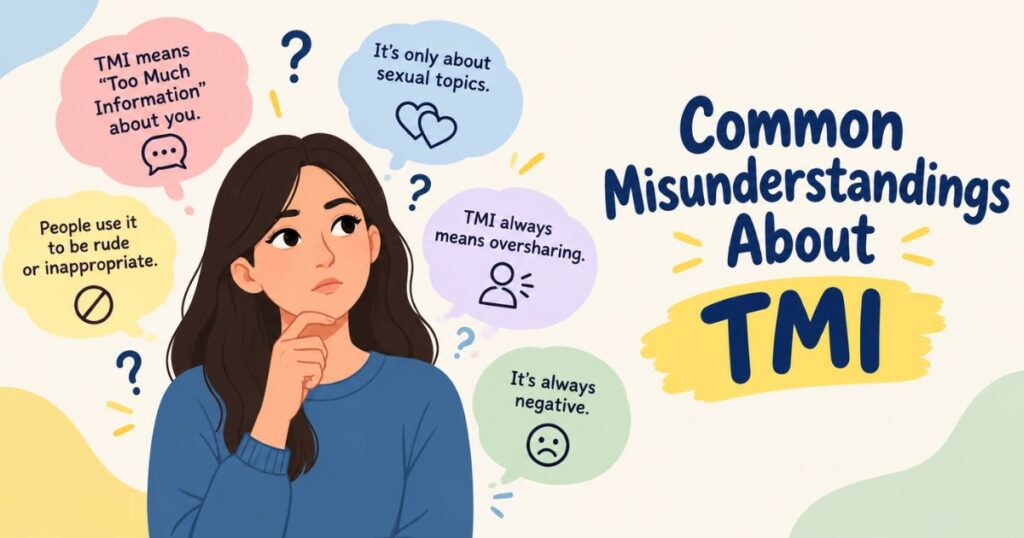
1. “TMI always means the person is being rude.” Not true. Many people say “TMI” about themselves, as in “This is TMI, but I tripped in front of everyone.” They use it as a joke.
2. “TMI means the information is false.” No. It says nothing about truth. The detail may be completely real. It is just more than the listener wanted.
3. “TMI is only about gross topics.” Gross topics are common, but not the only ones. Long personal stories, private relationship details, or endless money talk can all feel like TMI.
Also Read This: WYLL Mean In Text
4. “TMI is the same everywhere.” It is not. What feels like too much in one group may feel normal in another.
5. “TMI only means too much information.” In most chats, yes. Still, the same letters can point to something else in rare cases. For example, TMI is also a common shorthand for Three Mile Island, the site of a well-known 1979 nuclear accident in the United States. Context tells you which meaning is in play.
Comparison Table
TMI often gets mixed up with other slang and phrases. This table shows how they differ.
| Term | Meaning | Tone | Example |
| TMI | Too much information | Casual, teasing | “TMI, but I love your honesty.” |
| Overshare | Sharing more than is comfortable | Neutral to critical | “He overshares on every post.” |
| TL;DR | Too long; didn’t read | Casual, dismissive | “TL;DR, can you sum it up?” |
| NSFW | Not safe for work | Warning | “This link is NSFW.” |
| Spill the tea | Share gossip | Playful | “Come on, spill the tea.” |
| Say less | You do not need to explain more | Casual, friendly | “Say less, I am in.” |
The key difference is that TMI reacts to what was already said. TL;DR reacts to length. NSFW warns before content is seen. Each one has its own job.
Variations and Types of TMI
Not all TMI is the same. It comes in a few types, and knowing them helps you use the term with more care.
Personal TMI: Private life details, such as relationships, habits, or family issues.
Bodily TMI: Health, hygiene, or body-related details that feel too close for casual talk.
Emotional TMI: Deep feelings shared too early or in the wrong setting.
Digital TMI: Long posts, detailed status updates, or private screenshots shared in public spaces.
Funny TMI: Harmless details shared on purpose for laughs.
There are also common spin-offs of the word:
- “TMI alert”: A playful warning before a big overshare.
- “That was TMI”: A reaction after the fact.
- “Not TMI at all”: Used when someone welcomes the details.
- “Way too TMI”: A stronger version for a really awkward moment.
TMI meaning Medical

In everyday medical talk, TMI usually keeps its normal slang meaning. Patients often say, “Sorry, this is TMI,” before they describe a symptom. They feel shy or embarrassed.
Here is the important part: in a doctor’s office, there is almost no such thing as TMI. Doctors and nurses hear personal details all day. Small facts can help them find the right diagnosis.
Things patients sometimes hold back, but should share:
- Changes in sleep, appetite, or bathroom habits
- Pain that comes and goes
- Medicines, vitamins, and supplements
- Family health history
- Emotional or mental health changes
Some specialized medical fields may use their own abbreviations, and a few could share the same letters. If you see “TMI” in a medical document and the meaning is not clear, ask your care team. Do not guess.
The main lesson is simple. Do not let embarrassment stop you from telling your doctor the full story. Your health matters more than a moment of awkwardness.
How to Respond When Someone Uses TMI
Sometimes you are the one who overshared. Other times, you are the one who heard too much. Here is how to handle both sides.
If someone says TMI to you:
- Stay calm and do not take it personally.
- Laugh if the moment is light.
- Change the topic if they seem uncomfortable.
- Ask, “Should I stop there?” if you are unsure.
Sample replies:
- “Ha, fair. I will keep that one to myself.”
- “Got it, moving on.”
- “Sorry, that was a lot. Let me start again.”
If you need to say TMI to someone:
- Keep your tone kind.
- Add a smile, joke, or emoji.
- Avoid saying it to someone who is sharing pain or trauma.
- Offer a better path, such as “I want to hear this, just maybe in private.”
| Situation | Better Response |
| Friend shares a gross story | “TMI 😂 but thanks for the warning.” |
| Coworker shares a personal issue | “I care, but maybe we can talk about this outside work.” |
| Someone shares a real struggle | “Thank you for telling me. How can I help?” |
| You overshared by mistake | “Sorry, that was TMI. Let me reset.” |
Good manners matter more than clever slang. When in doubt, choose kindness.
Regional and Cultural Usage
TMI is used across the English-speaking world. You will hear it in the United States, the United Kingdom, Canada, Australia, India, Pakistan, and many other places. Younger people use it the most, but many older adults know it well.
Culture changes how it is received. In some places, people are open about personal matters and treat TMI as a light joke. In others, talking about private topics is less common, so TMI may appear more often, or feel stronger.
A few things to keep in mind:
- Direct cultures may use TMI freely and expect a laugh.
- Polite or reserved cultures may prefer softer wording, such as “that is quite personal.”
- Family settings can vary widely. Some households share everything. Others keep private matters private.
- Online spaces mix many cultures, so a joke may be read in ways you did not plan.
For people learning English, TMI is a helpful phrase to know. It shows up in movies, songs, and online videos. Just remember to match your tone to your audience.
Final Thoughts
TMI is a small phrase with a useful job. It helps people set boundaries, share a laugh, and keep chats comfortable. Knowing its origin, tone, and context makes it easier to use with confidence.
Remember that not every setting fits the term. Friends may love it, coworkers may prefer softer words, and doctors want your full story. Read the room, stay kind, and you will use TMI the right way.





One thought on “TMI Meaning: What It Really Means & When You Should Use It”