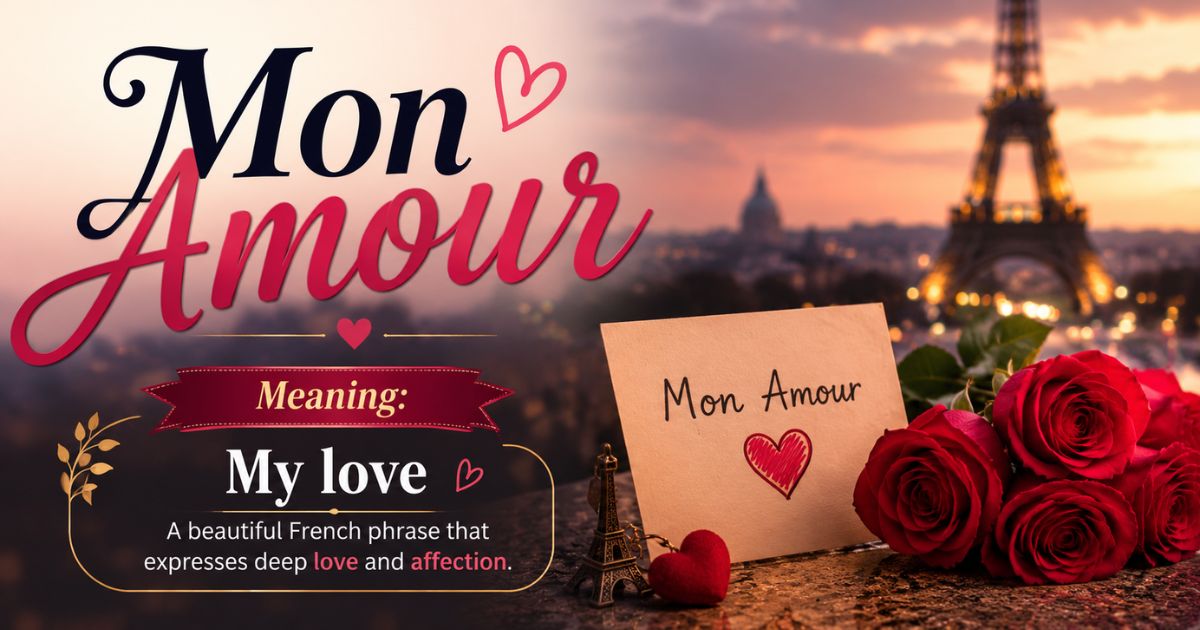

Mon amour means “my love” in French. It’s the phrase you hear in old films, in French pop songs, and in texts between people who want something softer than “babe.” Two words, one straightforward meaning, but a lot of nuance in how and when people actually use it.
Here’s the short answer: mon amour is pronounced “mohn ah-MOOR” and works as a term of endearment for a romantic partner, similar to “sweetheart” or “darling” in English. It’s not slang, it’s not new, and it’s not exclusive to romance movies. Below is everything worth knowing about where it comes from, how to say it correctly, and where people get it wrong.
Where Mon Amour Comes From
The phrase breaks down into two simple parts. “Mon” means “my,” and “amour” means “love.” Put together, you get a literal, unambiguous “my love.”
“Amour” itself traces back to the Latin word amor. That same root gave Spanish its amor, Italian its amore, and English words like “amorous” and “amateur” (someone who does something out of love, not for money). French softened the pronunciation over centuries, but the core meaning never drifted far from the original Latin.
The phrase has shown up in French romantic writing for hundreds of years, from handwritten love letters to poetry to modern text messages. It never went out of style. If anything, streaming, music, and social media pushed it further into everyday English-speaking use than it’s ever been.
The Grammar Bit (Worth Knowing)
French nouns carry gender, and this trips people up more than anything else about the phrase.
“Amour” is technically a masculine noun. Normally, the feminine form of “my” in French is “ma.” So logic suggests you’d say “ma amour” when speaking to a woman. That’s wrong.
French grammar has a rule that overrides gender when a feminine word starts with a vowel sound: you use the masculine possessive instead, purely because it sounds smoother. “Amour” starts with a vowel, so the rule kicks in.
| Situation | Correct Form | Incorrect Form |
| Speaking to a man | mon amour | — |
| Speaking to a woman | mon amour | ma amour |
| Speaking to a group or partner (any gender) | mon amour | — |
So no matter who you’re saying it to, the phrase stays exactly the same: mon amour. There’s no masculine or feminine version to remember, which actually makes it easier to use correctly than most French endearments.
How to Pronounce Mon Amour Without Sounding Awkward
Written French and spoken French don’t always match, and this phrase is a good example.
Break it into two pieces:
- Mon sounds like “mohn,” with a nasal vowel. Don’t pronounce the “n” the way you would in English. Instead, let the sound come out through your nose, similar to the “on” in the English word “don’t” if you drop the hard “t.”
- Amour sounds like “ah-MOOR,” with the stress on the second syllable. The “r” is softer than an English “r,” produced further back in the throat.
Put together, it comes out as “mohn ah-MOOR.” Say it at a normal pace and don’t over-enunciate each letter the way English speakers tend to do with foreign words. French tends to flow the syllables together rather than clipping them apart.
A quick trick that helps: say “own” instead of “on,” then add an “m” sound before it through your nose. That gets you close to the correct nasal vowel without needing formal pronunciation training.
How It Actually Gets Used, Not Just in Movies
Mon amour shows up far beyond period dramas and old French cinema. Real, current usage looks like this:
- Between romantic partners the most common context, used the way English speakers use “babe” or “honey.”
- In text messages a quick “bonjour mon amour” (good morning, my love) is a common way to start the day for couples, even outside French-speaking countries.
- In song lyrics French, English, Spanish, and even Hindi pop songs have borrowed the phrase because it carries romantic weight without needing translation.
- In wedding vows and speeches couples with French heritage, or simply a love for the language, often work it into ceremonies.
- On social media captions especially paired with couple photos or anniversary posts.
- In casual affection, not just deep declarations a partner might say it while handing you coffee, not only during a serious moment.
The phrase flexes depending on tone. Said softly, it reads as tender. Said with a laugh, it can be playful or even a little sarcastic between close partners. Context and delivery matter as much as the words themselves.
Mon Amour Song in English

Several songs have used “mon amour” in an English-language context or blended it into English lyrics, which is part of why the phrase feels familiar even to people who don’t speak French.
Shakira included it on her She Wolf album. Stromae and Camila Cabello released a track titled “Mon Amour” that mixes French and English. Zzoilo, Slimane, and Annalisa have also released songs under the same title in different years.
Beyond these, the phrase pops up as a lyric or hook inside countless pop, R&B, and indie songs because it delivers a strong emotional beat in just two syllables of sound.
The reason artists keep reaching for it isn’t complicated. “Mon amour” carries a romantic tone without sounding dated the way some English equivalents can, and it fits smoothly into a melody.
Mon Amour Messages That Show the Range
The same two words can carry very different weight depending on the sentence around them. A few examples:
- “Bonjour, mon amour.” Good morning, my love. Simple and affectionate.
- “Tu me manques, mon amour.” I miss you, my love. Common in long-distance messages.
- “Bonne nuit, mon amour.” Goodnight, my love. A gentle way to end the day.
- “Tu es mon amour.” You are my love. Feels more like a declaration than a casual greeting.
- “Joyeux anniversaire, mon amour.” Happy birthday, my love.
Notice the pattern: the phrase rarely stands alone. It’s usually attached to a greeting, a feeling, or an occasion, which is part of why it feels natural in texting rather than forced or overly formal.
Mon Amour vs. Mi Amor: The Question Everyone Asks
People mix these up constantly because they sound similar and mean exactly the same thing on paper.
| Mon Amour | Mi Amor | |
| Language | French | Spanish |
| Literal meaning | My love | My love |
| Pronunciation | mohn ah-MOOR | mee ah-MOR |
| Common tone | Soft, understated | Warm, expressive |
| Typical use | Romantic partners, occasionally close family | Romantic partners, and casually with friends, kids, or strangers in some regions |
The translation is identical. The feeling is not. French tends to lean quiet and reserved in how it expresses affection, while Spanish, especially in Latin American countries, uses “mi amor” more freely, sometimes even with a cashier or a stranger as a friendly gesture.
Neither approach is more romantic than the other. They just reflect different cultural habits around expressing warmth out loud.
If you’ve heard “mi amor” in a reggaeton track and “mon amour” in a French film, that contrast basically sums up the difference.
What Mon Amour Means in Urdu and South Asian Media

The phrase has found its way into South Asian pop culture too, most notably through the Bollywood song “Mon Amour” featuring Hrithik Roshan and Yami Gautam. In that context, and in general Urdu usage, the closest equivalent is mera pyar (my love) or meri mohabbat (my beloved).
The emotional register lines up closely. “Pyar” carries warmth and affection, while “mohabbat” leans toward something deeper and more devoted, similar to how “amour” carries more weight in French than the casual English word “love” sometimes does.
Also Read This:PM Meaning in Text
That overlap is likely why the phrase translated so smoothly into a Hindi film soundtrack without needing much cultural adjustment.
Mon Amour Meaning in English
Translated directly, mon amour means “my love” in English. There’s no hidden second meaning or slang twist. It functions as a term of endearment, the same category as:
- Sweetheart
- Darling
- Honey
- My dear
The main difference is tone. English equivalents can sound casual or even a little dated depending on who says them. “Mon amour” tends to land as more deliberate and romantic, partly because it’s foreign and partly because French has a reputation as a romantic language in English-speaking culture.
Other French Terms of Endearment for Context
Mon amour isn’t the only option in French, and knowing the alternatives helps you understand where it sits on the affection scale.
| Phrase | Meaning | Tone |
| Mon amour | My love | Deep, romantic |
| Mon chéri / Ma chérie | My darling | Common, slightly less intense |
| Mon cœur | My heart | Tender, intimate |
| Mon trésor | My treasure | Often used with children or partners |
| Ma belle | My beautiful one | Flirtatious, casual |
| Mon ange | My angel | Sweet, affectionate |
“Mon amour” generally sits at the more serious end of this list. “Mon chéri” is used more casually and more often, closer to how English speakers toss around “babe” throughout the day.
One Thing People Get Wrong About Using Mon Amour
The most common mistake isn’t grammar. It’s overused.
Because the phrase feels romantic and a little exotic to non-French speakers, people sometimes drop it into every single message, which flattens the impact. In actual French usage, even among couples, “mon amour” gets reserved for moments that carry a bit more weight: good morning, good night, missing someone, a birthday, a reunion at the airport. It’s not typically the default word for “hey” or “what’s up.”
The second mistake is trying to translate it too literally into unrelated contexts, like using it with a friend or a coworker the way “mon chéri” might be used more loosely in French. “Mon amour” specifically implies romantic love, so it’s best kept for a partner, not a general term of friendliness.
Conclusion
Mon amour means “my love,” and that translation hasn’t changed in centuries. What has changed is how far the phrase has traveled, from French poetry to Bollywood soundtracks to a quick text before bed. It works because it says exactly what it means without needing decoration.
Use it the way French speakers do: with intention, not as filler. Get the pronunciation close enough that it doesn’t sound forced, remember that the form never changes regardless of gender, and save it for the moments that actually call for it. That’s really the whole trick to using mon amour right.